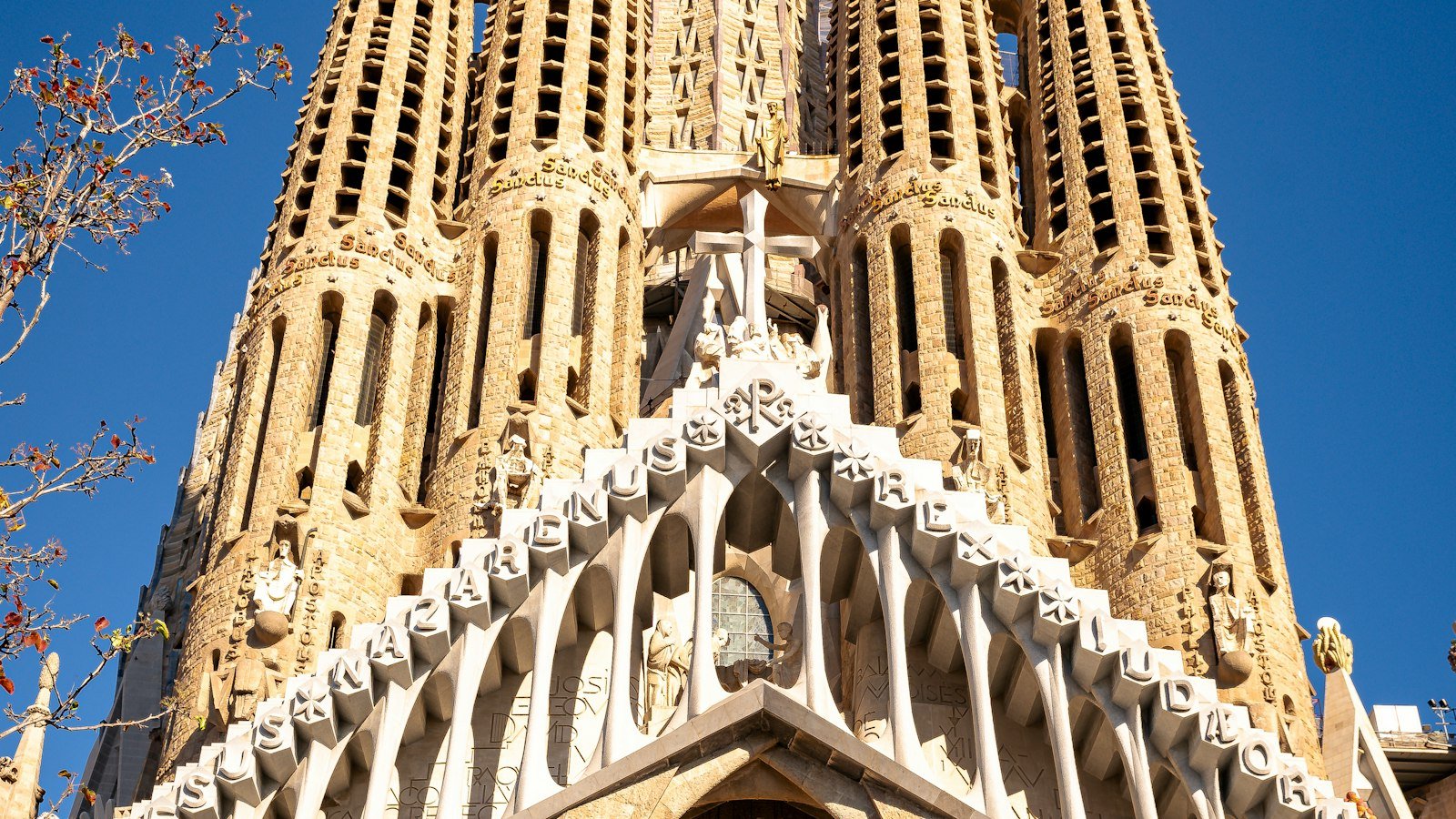
Last updated: 14 November 2026. This guide contains affiliate links; if you book through one we may earn a commission at no extra cost to you. How we make money.
Short answer: three days in Barcelona works if you split the city by geography rather than by theme. Day 1 is Gaudí in the Eixample: the Sagrada Família at opening, then one of the two Passeig de Gràcia houses, Casa Batlló or La Pedrera. Day 2 is the old town on foot: the Boqueria market early, the Cathedral, the Palau de la Música and the Picasso Museum, with dinner in El Born. Day 3 starts at Park Güell, drops down through Gràcia for lunch and ends on Montjuïc with the art museum, the view and, from Thursday to Saturday, the Magic Fountain. Book the Sagrada Família and Park Güell before you fly: both sell timed tickets online and both turn late arrivals away.
At a glance
| Day | Area | Theme |
|---|---|---|
| Day 1 | Sagrada Família, Eixample, Passeig de Gràcia | Gaudí’s basilica and his two apartment buildings, dinner on Rambla de Catalunya |
| Day 2 | La Rambla, Gothic Quarter, El Born | The Boqueria, the Cathedral, the Palau de la Música, Picasso and a long dinner |
| Day 3 | Park Güell, Gràcia, Montjuïc | Gaudí’s park, neighbourhood squares for lunch, the hill, the museum and the fountain |
The practical bit
- Best months: April to June and September to October, when it is warm enough to eat outside and the beach is still usable in early autumn. July and August are hot, crowded and the most expensive for hotels. November to March is the cheapest time, with shorter opening hours.
- Pace: moderate. One timed ticket each morning, one more sight in the afternoon, and a late dinner. Barcelona eats late: many kitchens do not start serving dinner until 8:30 or 9 pm.
- Budget per person per day: about €45–€60 (roughly $50–$67 / £38–£50) in tickets and public transport on this plan, before food, hotels and the tourist tax.
- Book ahead: the Sagrada Família (online only, named and timed), Park Güell (timed), and whichever Gaudí house you choose. The Palau de la Música tour and the Picasso Museum are worth booking in busy months.
- Days to watch: the Boqueria is closed on Sundays. The Picasso Museum and the Museu Nacional (MNAC) are closed on Mondays. The Sagrada Família opens later on Sundays, at 10:30 am. The Magic Fountain only runs from Thursday to Saturday in winter.
In this guide
- Day 1: the Sagrada Família and Passeig de Gràcia
- Day 2: the Boqueria, the Gothic Quarter and El Born
- Day 3: Park Güell, Gràcia and Montjuïc
- Ticket prices in one table
- Getting around and the airport
- What we’d change
- FAQ
Day 1: the Sagrada Família and Passeig de Gràcia
Day 1 is the reason most people come. The basilica goes first because the earliest slot is the calmest one, and the rest of the day follows the metro and Passeig de Gràcia south towards the old town. It is a flat day with little walking between sights, which makes it a good arrival-day plan if you land the night before.
Base yourself in the Eixample. It is flat, safe at night, on several metro lines and within a 20-minute walk of the old town, so every day of this plan starts within easy reach. Hotel Constanza is a 46-room boutique hotel at Carrer del Bruc 33, under five minutes on foot from Urquinaona metro, with a rooftop terrace that opens in the warmer months. For more space and a better address, Hotel Casa Sagnier has 51 rooms at Rambla de Catalunya 104, a short walk from both Gaudí houses, with a rooftop lounge. The full neighbourhood breakdown, including El Born and Gràcia, is in our Where to Stay in Barcelona guide. See all hotels in the Eixample →
9:00 am: the Sagrada Família
Take metro line 2 or 5 to Sagrada Família station. Individual visitors use the entrance on the Nativity façade, on Carrer de la Marina. From November to February the basilica opens at 9:00 am from Monday to Saturday and at 10:30 am on Sundays, and closes at 6:00 pm; from April to September weekday closing moves to 8:00 pm. Tickets are sold only online, for a fixed date and time, in your own name, and late arrivals are refused.
As of November 2026 the basic ticket with the audioguide app is €26 (about $29 / £22) and the ticket with a tower climb is €36 (about $40 / £30), with under-11s free on both, according to the official Sagrada Família site. We would pay for the tower once: the view down onto the spires is the only way to understand the scale of the building. Lockers are provided for bags on tower visits, but there is nowhere to leave a suitcase, so do not come straight from the airport. Shoulders and upper legs should be covered.
Allow two hours with a tower, 90 minutes without. Walk round the outside afterwards to compare the Nativity façade, the one Gaudí oversaw, with the angular Passion façade on the opposite side. The central Tower of Jesus Christ, blessed in June 2026 for the centenary of Gaudí’s death, is not open to visitors and is not part of any ticket. One note from our research: when we checked in November 2026, the official ticket page carried a general “temporarily closed” notice with no dates, while the official schedule and events pages showed normal opening. Check the ticket page before you build a day around it.
11:30 am: coffee and the metro to Diagonal
The streets right around the basilica are the most tourist-priced in the Eixample. Walk a few blocks away for coffee, then take line 5 three stops to Diagonal, which comes up at the top of Passeig de Gràcia. Have an early lunch near Rambla de Catalunya, the pedestrian boulevard that runs parallel to it.
1:30 pm: La Pedrera (Casa Milà)
Gaudí’s wave-fronted apartment block at Passeig de Gràcia 92 is two minutes from Diagonal station. The self-guided La Pedrera Essential ticket starts at €29 (about $32 / £24), and children up to 11 go free. In winter, from 2 November 2026 to 25 February 2027, it is open daily from 9:00 am to 6:30 pm; summer hours run to 8:30 pm. The building’s own La Pedrera site was offering 10% off the Essential ticket during November 2026. The highlight is the rooftop, with its sculpted chimneys, followed by the attic of brick arches and a period apartment. Allow 75 minutes.
3:00 pm: Casa Batlló, or just its façade
Walk seven or eight minutes down Passeig de Gràcia to number 43. Casa Batlló, the house with the bone-like balconies and the scaled roof, is open every day from 9:00 am, with the general visit from €29 online and last daytime access at 7:45 pm, per the official Casa Batlló site. Buying online saves a few euros over the door price. It runs a winter night visit until 10 January, from €39.
Our honest view: on a three-day trip, pick one of the two houses to go inside. Choose La Pedrera for the roof and the sense of how people lived there; choose Casa Batlló for the interiors, which are the more theatrical of the two. Then look at the other from the pavement, which costs nothing. Doing both inside in one afternoon is a lot of Gaudí and close to €60 a head.
5:00 pm: Rambla de Catalunya and an early-evening vermouth
Walk back up Rambla de Catalunya under the plane trees. This is the hour for a vermouth and something small, the local habit before dinner. Shops on Passeig de Gràcia stay open into the evening if you want them.
8:30 pm: dinner in the Eixample
Eat in the left Eixample, towards Carrer d’Enric Granados and Sant Antoni, where restaurants serve people who live here rather than people passing through. Book anything you have your heart set on, especially Thursday to Saturday.
Day 2: the Boqueria, the Gothic Quarter and El Born
Day 2 is all on foot and almost all inside the old town, the Ciutat Vella. It moves from La Rambla across the Gothic Quarter to El Born, and every stop is within ten minutes’ walk of the next. Do it on a weekday if you can: the Boqueria is shut on Sundays, the Picasso Museum on Mondays, and the Cathedral keeps Sunday mornings for worship.
8:30 am: the Boqueria
Take line 3 to Liceu. The Mercat de la Boqueria on La Rambla is open Monday to Saturday from 8:00 am to 8:30 pm and is free to enter, though each stall keeps its own hours. Early morning is the time to see it working, before the tour groups fill the front aisles. The stalls nearest La Rambla sell fruit cups and juices at visitor prices; walk to the back for the fishmongers, butchers and the counter bars where you can sit for breakfast. The market is being renovated from 2026 but stays open throughout.
9:45 am: through the Gothic Quarter to the Cathedral
Cross La Rambla and walk into the Barri Gòtic by Carrer de la Boqueria. Take the long way: Plaça Sant Jaume, with the city hall and the Catalan government facing each other, then the small Plaça de Sant Felip Neri, the quietest square in the old town.
Barcelona Cathedral, La Seu, is open for cultural visits from 9:30 am to 6:30 pm on weekdays, to 5:15 pm on Saturdays, and from 2:00 pm to 5:00 pm on Sundays. The tourist ticket costs around €11 (about $12 / £9) and includes the cloister, with its resident geese, and the lift to the rooftop terraces. The free worship-time entry does not include the roof. Cover shoulders and knees. Allow 45 minutes.
11:30 am: the Palau de la Música Catalana
Walk about ten minutes north-east across Via Laietana to the concert hall. The Palau is the best Modernista interior in the city that is not by Gaudí, with a stained-glass skylight that hangs over the auditorium like an inverted dome. The only way in outside concerts is a tour. The guided tour runs between 9:00 am and 3:30 pm, takes about 55 minutes and costs €24 (about $27 / £20) as of November 2026, with under-10s free and €20 for under-35s and over-65s. Book a slot on the Palau de la Música site; tours run in English as well as several other languages.
1:00 pm: lunch in El Born
Walk five minutes south into El Born. Most restaurants here offer a weekday set lunch, the menú del día, which is the best-value meal you will eat in Barcelona. Ask for it if it is not on the table. Then walk past Santa Maria del Mar, the 14th-century church that locals consider the finest Gothic building in the city.
3:00 pm: the Picasso Museum
The museum fills five medieval palaces on Carrer de Montcada, five minutes from Jaume I metro on line 4. Its strength is the young Picasso: the academic paintings he made as a teenager in Barcelona, and the long series of variations on Velázquez’s Las Meninas. It is closed on Mondays, and adult tickets cost about €12 for the permanent collection or around €14 with the temporary exhibitions, according to recent visitor guides; under-18s go free. Entry is free on the first Sunday of each month and on winter Thursday afternoons from 4:00 pm, but those free slots must be booked online and are released only a few days ahead. Paid tickets are timed too. Allow 90 minutes.
5:00 pm: Parc de la Ciutadella and the Arc de Triomf
Walk east to the city’s central park, past the Cascada fountain, and out to the red-brick Arc de Triomf at the top of Passeig de Lluís Companys. In summer, carry on 15 minutes to the beach at Barceloneta for sunset instead. If El Born suits you better as a base, Motel One Barcelona-Ciutadella sits about 400 metres from Arc de Triomf metro, has 255 rooms and a rooftop terrace looking over the park towards the sea, and is usually one of the cheaper well-rated hotels near the old town.
8:30 pm: dinner and drinks in El Born
Go back to El Born for the evening. This is the densest cluster of good tapas bars, wine bars and cocktail bars in the centre, and it stays busy late from Thursday to Sunday. Eat standing at a bar for a few plates, then move on.
Day 3: Park Güell, Gràcia and Montjuïc
The last day uses both of Barcelona’s hills: Gaudí’s park on the north side in the morning, and Montjuïc above the port in the afternoon. Line 3 joins the two in one ride, which is what makes the plan work. Do not swap Park Güell into Day 1; it is a long way from the Sagrada Família and the two together make an exhausting morning.
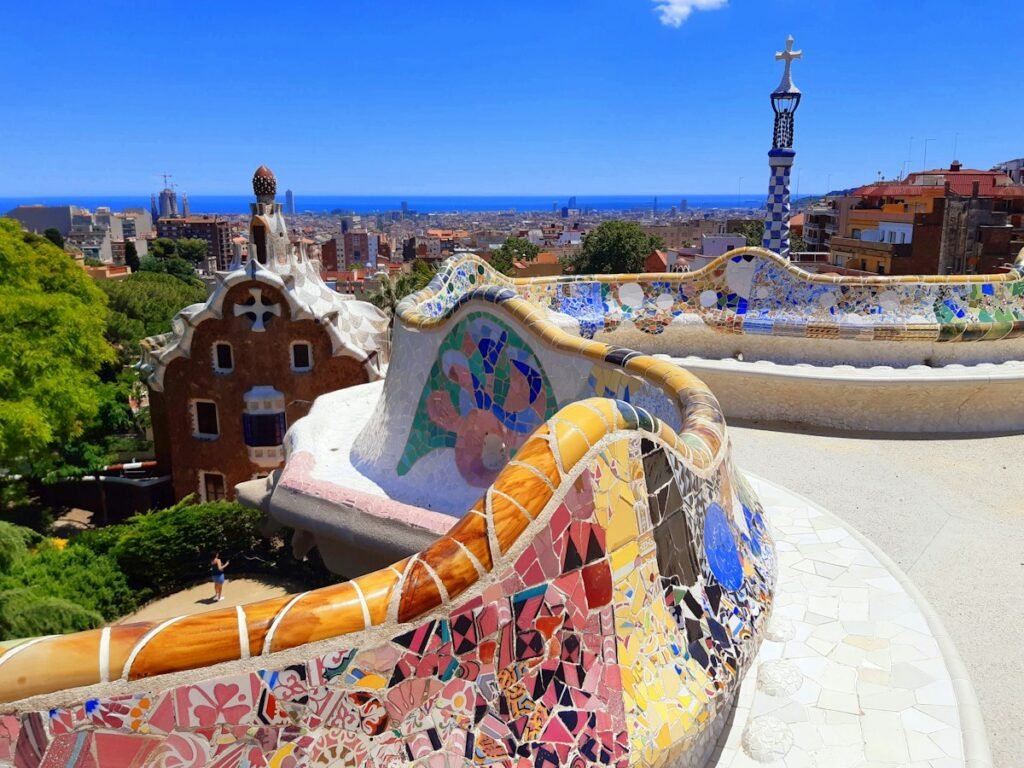
9:30 am: Park Güell
The paid Monumental Zone holds everything you have seen in photographs: the mosaic dragon on the stairs, the hall of columns and the long curving bench on the terrace. General admission is €18 (about $20 / £15) as of November 2026, with a reduced €13.50 rate for children aged 7 to 12 and over-65s, and free entry for under-7s, per the official Park Güell site. Tickets are timed, with slots from 9:30 am. You can enter up to 30 minutes after your slot starts; after that the ticket is lost. Once inside you can stay as long as you like, but you cannot re-enter.
Getting there takes longer than people expect. From Lesseps or Vallcarca on line 3 it is about a 20-minute walk uphill, partly helped by escalators from Lesseps. The H6 or D40 bus to Travessera de Dalt cuts the walk to about ten minutes. Take the first slot of the day: the light is better, the terrace is quieter, and the rest of the plan depends on leaving by 11:30. Allow 90 minutes. The Gaudí House Museum inside the park was closed for maintenance when we checked.
11:45 am: walk down into Gràcia
Walk downhill for about 20 minutes into Gràcia, once a separate town and still run like one: small streets, independent shops and a chain of squares, Plaça del Sol, Plaça de la Virreina and Plaça de la Vila. Eat lunch on one of them. If you would rather stay up here, Hotel Casa Fuster is a five-star hotel with 96 rooms in a Modernista building at Passeig de Gràcia 132, by Diagonal metro, with a rooftop bar and plunge pool on the edge of Gràcia.
2:00 pm: line 3 to Plaça d’Espanya
From Fontana or Diagonal, ride line 3 south to Espanya, about 15 minutes. Come up between the two brick towers on Avinguda de la Reina Maria Cristina and walk towards the hill. The outdoor escalators beside the fountains carry you most of the way up to the museum.
2:30 pm: the Museu Nacional d’Art de Catalunya (MNAC)
The domed palace at the top of the steps holds the best Romanesque church murals in the world, removed from Pyrenean chapels a century ago and reinstalled in apses built to fit them. General admission is €12 (about $13 / £10), covers the collections and the rooftop viewpoint, and is valid on two days within a month. From October to April it opens Tuesday to Saturday from 10:00 am to 6:00 pm, and Sundays from 10:00 am to 3:00 pm; it is closed on Mondays. Entry is free every Saturday from 3:00 pm and on the first Sunday of the month, but you need to reserve online. Details are on the MNAC site. Allow two hours, and do not skip the roof terrace.
4:45 pm: the view from Montjuïc
Step out onto the terrace in front of the museum for the classic view back down the avenue to Plaça d’Espanya and across the city to Tibidabo. If you have energy and light left, the Montjuïc cable car runs from the park up to the castle. It is open from 10:00 am to 6:00 pm in November and December, and a one-way adult ticket is €12 (about $13 / £10) according to the Telefèric de Montjuïc fares page. If you are staying on this side of the city, Hotel Brummell is a 20-room hotel at Nou de la Rambla 174 at the foot of the hill, with an outdoor pool.
8:00 pm: the Magic Fountain, then dinner in Poble Sec
From November to March the Magic Fountain of Montjuïc runs on Thursday, Friday and Saturday evenings between 8:00 and 9:00 pm, with music-and-light shows starting at 8:00 and 8:30 pm, according to the Barcelona city council. It was switched off for annual maintenance from 1 to 15 November 2026, so check the page if you are visiting right after that. It is free. Afterwards walk ten minutes into Poble Sec, where Carrer de Blai is lined with pintxo bars that charge per stick. If your last day is not Thursday to Saturday, skip the fountain and go straight to dinner.
Ticket prices in one table
Prices below are for a standard adult as of November 2026. Conversions use the European Central Bank reference rate of early November 2026 (€1 = $1.1165 / £0.8342), rounded.
| Sight | Adult price | Roughly in USD / GBP | Closed or limited | Book ahead? |
|---|---|---|---|---|
| Sagrada Família (audioguide) | €26 | $29 / £22 | Opens 10:30 am on Sundays | Yes, online only |
| Sagrada Família with towers | €36 | $40 / £30 | As above | Yes, online only |
| La Pedrera Essential | From €29 | $32 / £24 | Closed 25 December | Recommended |
| Casa Batlló general visit | From €29 online | $32 / £24 | Open daily | Recommended |
| Barcelona Cathedral (tourist visit) | About €11 | $12 / £9 | Sunday mornings for worship | No |
| Palau de la Música guided tour | €24 | $27 / £20 | Tours 9:00 am–3:30 pm | Yes |
| Picasso Museum | About €12–€14 | $13–$16 / £10–£12 | Mondays | Yes, timed |
| Park Güell | €18 | $20 / £15 | Open all year | Yes, timed |
| MNAC | €12 | $13 / £10 | Mondays | No (yes for free slots) |
| Montjuïc cable car, one way | €12 | $13 / £10 | 10 am–6 pm in Nov–Dec | No |
| Magic Fountain | Free | Free | Thu–Sat only in winter | No |
With one Gaudí house, the tower climb and the cable car, the tickets on this plan come to about €160 per person. Children under 11 are free at the Sagrada Família and La Pedrera, and under 12 at Casa Batlló, which makes Barcelona better value for families than the headline prices suggest.
Getting around and the airport
The metro. Barcelona’s metro is quick and easy, and on this itinerary you will mostly use lines 2, 3, 4 and 5. A single ticket costs €2.90 and the T-casual, ten journeys in zone 1, costs €13 under the fares in force since January 2026, bringing each ride down to €1.30. One T-casual between two people covers most of this plan. A 24-hour T-dia is €12 if you prefer unlimited rides for a day. Fares and maps are on the TMB site.
From the airport. The dedicated airport metro ticket on line 9 Sud costs €5.90 and the T-casual is not valid at the airport stations. The Aerobús to Plaça de Catalunya is simpler with luggage; our Barcelona where-to-stay guide has the current fares, the train option and taxi costs.
Tourist tax. Catalonia’s overnight-stay tax doubled in April 2026 and Barcelona adds its own surcharge on top, so expect several euros per person per night, usually collected at check-in. The amounts by hotel category are in the where-to-stay guide linked above.
A safety note. Barcelona is safe for visitors in the sense that matters most; the problem is theft. La Rambla, the Boqueria, crowded metro carriages and café terraces are where phones and wallets go missing. Keep your phone off the table and your bag zipped in front of you, especially on Day 2.
What we’d change
Two days only: keep Day 1 as written and merge Days 2 and 3. Do the Boqueria, the Cathedral and El Born in the morning, then Park Güell on an afternoon slot. Montjuïc is the part to drop.
For the best free view in the city: swap Montjuïc for the Bunkers del Carmel, the old anti-aircraft battery on Turó de la Rovira, close to Park Güell. It is free but fenced and locked outside its hours, which are 9:00 am to 5:30 pm from October to April and to 7:30 pm from May to September. That means a sunset visit is realistic only in the winter months, when the sun goes down before the gate closes. Bus 22 gets closest; from the El Carmel or Alfons X metro stations it is a 15 to 20-minute uphill walk with no shade.
In summer: put the beach into Day 2. After the Picasso Museum, walk 15 minutes to Barceloneta, or take line 4 to the calmer beaches at Bogatell. Move Park Güell to the first slot and do Montjuïc after 5 pm, when the hill cools down and MNAC’s summer hours run to 8:00 pm.
On a Monday: the Picasso Museum and MNAC are both closed, so make Monday your Day 1. Travelling light helps on a short city trip like this; our carry-on packing list works just as well for three days.
FAQ
Is three days enough for Barcelona?
For a first visit, yes. Three days covers the Sagrada Família, one Gaudí house, Park Güell, the old town and Montjuïc at a comfortable pace. Add a fourth day for the beach or a day trip to Montserrat or Girona.
How far ahead should I book the Sagrada Família?
As soon as your dates are fixed. Tickets are sold only online, for a named person and a fixed time, and morning slots go first in spring, summer and around holidays. Independent guides report that sales open around two months ahead. Do not buy from street sellers; tickets carry your name.
Casa Batlló or La Pedrera if I only do one?
Casa Batlló for the most striking interiors, La Pedrera for the rooftop and a calmer visit. Both start at €29. You can see the façade of the one you skip for free; they are a few minutes apart on Passeig de Gràcia.
Is Park Güell free?
Not for visitors. The Monumental Zone, where the famous terrace and dragon are, costs €18 with a timed slot. The early-morning and evening free windows are reserved for local residents with a park pass.
Where should I stay for a three-day trip?
The Eixample, between Plaça de Catalunya and Passeig de Gràcia. It puts you on the metro lines this plan uses and within walking distance of the old town. Hotel Constanza is our default pick for a first trip. For more options, and how to book well ahead of a busy season, see how far in advance to book a hotel.
How we researched this: ticket prices, opening hours and closing days were checked in November 2026 on the official sites of the Sagrada Família, Park Güell, La Pedrera, Casa Batlló, the Palau de la Música Catalana, the Museu Nacional d’Art de Catalunya, the Montjuïc cable car and Barcelona city council’s Magic Fountain page, alongside 2026 transport fare reports, recent visitor guides for the Picasso Museum, the Cathedral, the Boqueria and the Bunkers del Carmel, independent Barcelona itineraries, and hotel details from hotel guides and booking sites. Prices change often; confirm before you travel.
Leave a Reply