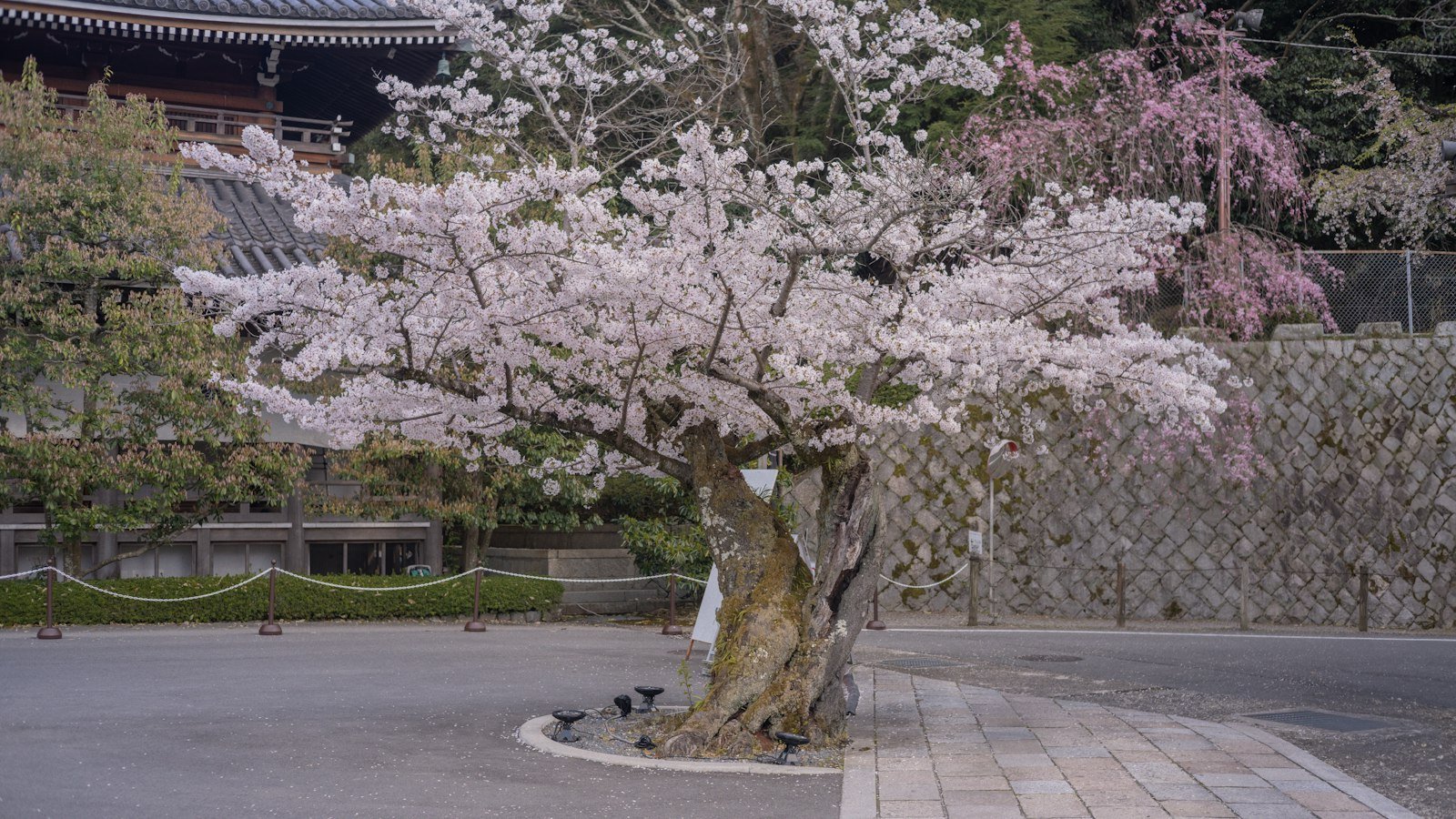
Last updated: 31 October 2026. This guide contains affiliate links; if you book through one we may earn a commission at no extra cost to you. How we make money.
Short answer: there is no official 2027 cherry blossom forecast yet, and anyone who tells you otherwise is guessing. The first forecasts from Japan’s private weather companies normally appear between mid-December and late January. Until then, plan around the long-term averages: Tokyo usually opens around 24 March and peaks around 31 March, Kyoto and Osaka peak around 4 April, and the north runs two to four weeks later. If you want one base, pick Kyoto for the last days of March into the first week of April and accept the prices. If you want insurance against an early or late season, split the trip between Tokyo and Kyoto, or Kyoto and the Tohoku region, so the second half catches what the first half missed.
In this guide
- Is there an official 2027 forecast yet?
- Expected 2027 dates, city by city
- Where to go: four trips that work
- What hotels cost in cherry blossom season, and when to book
- Accommodation taxes you will pay in spring 2027
- How to hedge against an early or late season
- FAQ
Is there an official 2027 forecast yet?
No. As of the end of October 2026, the Japan Meteorological Corporation forecast page still shows its final 2026 bulletin, issued on 23 April 2026, and says the season’s announcements have ended. Weathermap’s English forecast page is likewise still on 2026. The Japan Meteorological Agency, the government body, stopped publishing its own blossom forecast years ago; it only records the dates when the sample trees actually open.
The timetable that matters is the private forecasters’ release schedule. For the 2026 season, the Japan Meteorological Corporation published its first outlook on 18 December 2025, Weathermap issued its first forecast on 22 January 2026, and the Japan Weather Association followed in late January. Expect the same pattern for 2027: a first long-range outlook in the second half of December, revisions from late January, and daily bloom reports from early March. The forecast only becomes reliable two to three weeks before the trees open, once the February and March temperatures are known. So every “2027 forecast” online right now, including the table below, is a planning estimate built on averages and recent years. Treat it as a booking window, not a promise.
Expected 2027 dates, city by city
The “normal” column is the official 30-year average (1991–2020) used by the Japan Meteorological Agency and quoted in the Japan Meteorological Corporation’s bulletins. The 2026 columns show what actually happened last spring, when warm weather in early March brought most of Japan into bloom early, by anywhere from one day in Osaka to thirteen in Sapporo; only Fukuoka and Kagoshima ran a day or two late. Full bloom typically follows first bloom by about a week, and the best viewing runs from full bloom to roughly five days after it.
| City | Normal first bloom | 2026 first bloom | 2026 full bloom | Plan your 2027 stay around |
|---|---|---|---|---|
| Fukuoka | 22 March | 24 March | 3 April | 24 March – 4 April |
| Hiroshima | 25 March | 19 March | 30 March | 25 March – 4 April |
| Osaka | 27 March | 26 March | 3 April | 28 March – 7 April |
| Kyoto | 26 March | 23 March | 30 March | 27 March – 6 April |
| Nagoya | 24 March | 17 March | 30 March | 25 March – 4 April |
| Tokyo | 24 March | 19 March | 28 March | 24 March – 3 April |
| Kanazawa | 3 April | 29 March | 3 April | 2 – 10 April |
| Sendai | 8 April | 31 March | 4 April | 6 – 14 April |
| Hirosaki / Aomori | 22 April | 13 April | 16 April | 18 – 30 April |
| Sapporo | 1 May | 18 April | 24 April | 26 April – 6 May |
Two things stand out. The gap between Tokyo and Kyoto is small, usually two to four days, so a week that covers both will see roughly the same stage of bloom in each. The north, though, is a different season: Sendai peaks when Tokyo’s petals are on the ground, and Hirosaki and Sapporo run three to four weeks behind. That is the lever to pull if your dates are fixed and the forecast turns against you. The 2026 column is also a warning: Nagoya opened a week early and Sapporo thirteen days early, and recent springs have leaned early more often than late.
Where to go: four trips that work
Tokyo: the easy one
Tokyo is the right choice for a first visit or a short one, because the blossom is everywhere and you do not have to travel to find it. Shinjuku Gyoen is the single best garden in the city for it: ¥500 for adults, open every day without the usual Monday closure during its spring special period, which the garden lists as 25 March to 24 April. Buy the e-ticket in advance to skip the gate queue. Add the Meguro river at dusk and the Chidorigafuchi moat by rowing boat.
Base yourself in Shinjuku, which puts you a short walk from the garden and on every rail line you need. Hotel Gracery Shinjuku is the dependable mid-range pick, typically ¥22,000–¥32,000 (about $140–$205 / £105–£155) a night outside peak weeks. Citadines Shinjuku gives you a kitchenette for similar money, useful for a week-long stay. Our Tokyo area guide covers the alternatives, and the five-day itinerary is easy to rearrange around the parks. See all hotels in Shinjuku →
Kyoto and Nara: the famous one
Kyoto in the first week of April is the trip most people have in mind, and it deserves its reputation: the Philosopher’s Path, the Kamo river banks and Maruyama Park’s weeping cherry. It is also the most expensive and most crowded week of the Kyoto year, when a room costs double what it does in February.
Stay Downtown, around Shijo and Kawaramachi, so you can walk to Gion and the river and still reach the temples by subway before the buses fill. Cross Hotel Kyoto is the hotel we recommend most often there, normally ¥25,000–¥38,000 ($160–$240 / £120–£185) before the spring premium. On a budget, Onyado Nono Kyoto Shichijo, five minutes from Kyoto Station, has tatami floors and a hot-spring bath and runs ¥11,500–¥19,000 ($75–$120 / £55–£90) in ordinary weeks. The full comparison is in our Kyoto area guide, and the three-day Kyoto itinerary includes the Nara day trip, which is worth keeping in a blossom week: the deer park is one of the few places where the crowds thin out. See all hotels in Downtown Kyoto →
Osaka and Himeji: the late-season one
Osaka is the base we would choose if the forecast shifts late or if Kyoto’s prices put you off. Osaka Castle Park is a fine place to see the main Somei Yoshino bloom, but the city’s real event comes a week after it. The Japan Mint’s Sakura no Torinuke opens a walkway of late-flowering varieties for one week each April: in 2026 it ran from 9 to 15 April with 331 trees of 140 varieties, entry was by advance registration with a timed QR code, and the 2027 dates had not been announced when we checked. It is the best single hedge in Japan for a trip that arrives after the Somei Yoshino have gone.
From Osaka, Himeji Castle is a short Shinkansen hop and is the postcard with the white keep behind the blossom; adult admission is ¥2,500, hours 9:00 to 17:00 with last entry at 16:00. For a base, Cross Hotel Osaka in Namba usually runs ¥17,000–¥25,000 ($110–$160 / £80–£120), and Hotel Granvia Osaka inside Osaka Station is the practical choice for day trips at ¥18,000–¥28,000 ($115–$180 / £85–£135). Osaka mid-range hotels undercut Kyoto’s by roughly a third, and Kyoto is a short train ride away on the Shinkansen or the Hankyu line. See all hotels in Namba →
Hirosaki and the north: the one for late April
If you can only travel in the second half of April, go north rather than hoping Kyoto runs late. The Hirosaki Cherry Blossom Festival has already published its 2027 dates, 16 April to 5 May, in Hirosaki Park, which has about 2,600 trees of 52 varieties around the castle moats. The combined ticket for the inner keep area, the botanical garden and the Fujita Memorial Garden is ¥520 for adults. One caveat for 2027: the castle keep is being moved back onto its stone foundation during late 2026, after which the tower’s interior will stay closed for several years. The moats, the petal-covered water and the night illuminations are unaffected, and they are the reason to come.
Getting there from Tokyo takes about 3 hours 40 minutes plus the change: the Hayabusa Shinkansen to Shin-Aomori in roughly 3 hours 10 minutes, then the Tsugaru limited express for 30 minutes. Hotels in Hirosaki are small and few, so book the festival nights as soon as you commit. Sapporo, with a normal first bloom around 1 May, is the other late option. See all hotels in Hirosaki →
What hotels cost in cherry blossom season, and when to book
Cherry blossom week is the most expensive week in the Japanese hotel calendar outside Golden Week, and Kyoto is the extreme case. The price guides we checked put late-March rates 30–50% above baseline, with the peak week of early April running 60–100% above baseline in Kyoto and 40–70% above in Tokyo and Osaka. The table shows a typical mid-range double in a normal week and what the same room tends to cost in the first week of April.
| City | Mid-range double, ordinary week | Same room, peak blossom week | Roughly in USD / GBP at peak |
|---|---|---|---|
| Tokyo | ¥18,000–¥30,000 | ¥25,000–¥50,000 | $160–$320 / £120–£240 |
| Kyoto | ¥20,000–¥35,000 | ¥32,000–¥70,000 | $205–$445 / £155–£335 |
| Osaka | ¥13,000–¥22,000 | ¥18,000–¥37,000 | $115–$235 / £85–£180 |
| Fukuoka | ¥11,000–¥18,000 | ¥15,000–¥30,000 | $95–$190 / £70–£145 |
| Sapporo | ¥14,000–¥22,000 | ¥20,000–¥37,000 | $125–$235 / £95–£180 |
When to book: four to six months ahead for Tokyo, Kyoto and Osaka, which means by December 2026 for the first week of April. Top ryokan and the small luxury hotels sell out six to nine months out. What makes this bearable is the free-cancellation rate: book your preferred dates now at a refundable rate, then adjust when the first forecasts land in December and January. The ¥500–¥1,000 a night the refundable option costs is the cheapest travel insurance you will buy.
Flexible on city but not on dates? Book Osaka or Fukuoka rather than Kyoto. Flexible on dates but not on city? Hold Kyoto for both 28 March to 2 April and 3 to 7 April, and cancel whichever the forecast rules out.
Accommodation taxes you will pay in spring 2027
Japan’s lodging taxes are charged per person per night, scale with the room rate, and are usually collected at check-in rather than included in the online price. Tokyo’s changes on 1 April 2027, in the middle of the blossom season.
- Tokyo. Until 31 March 2027 the tax is ¥100 per person per night on rooms costing ¥10,000–¥14,999 and ¥200 on rooms of ¥15,000 or more, in hotels and ryokan only. From 1 April 2027, under the ordinance announced by the Tokyo Metropolitan Government on 30 June 2026, it becomes 3% of the room charge, with stays under ¥13,000 per person exempt, and it extends to hostels, guesthouses and private rentals. A couple in a ¥40,000 room pays ¥400 a night under the old rules and ¥1,200 under the new.
- Kyoto. Raised on 1 March 2026 to the highest in Japan, per the Kyoto City Official Travel Guide: ¥200 under ¥6,000; ¥400 for ¥6,000–¥19,999; ¥1,000 for ¥20,000–¥49,999; ¥4,000 for ¥50,000–¥99,999; ¥10,000 for ¥100,000 and above. Note that a ¥35,000 room in a normal week and the same room at ¥55,000 in blossom week fall in different bands, so the tax quadruples along with the price.
- Osaka Prefecture. Nothing under ¥5,000; ¥200 for ¥5,000–¥14,999; ¥400 for ¥15,000–¥19,999; ¥500 for ¥20,000 and above. The band structure applies across the whole prefecture.
- Sapporo. A new combined city and Hokkaido tax began on 1 April 2026: ¥300 under ¥20,000, ¥400 for ¥20,000–¥49,999 and ¥1,000 from ¥50,000.
- Fukuoka City. ¥200 under ¥20,000 and ¥500 from ¥20,000, combining the prefectural and city levies.
Several more prefectures, including Hiroshima, Nagano and Miyagi, introduced taxes of ¥200–¥300 a night during 2026. None of this will break a budget, but keep some cash for check-in.
How to hedge against an early or late season
Split the trip south to north. Start in Kyoto or Osaka in the last days of March and finish in Tokyo in early April, or start in Tokyo and finish in Sendai or Hirosaki. The second city is always a few days behind the first, so an early season that catches you out in the first stop is still there in the second.
Favour places with mixed varieties. The Somei Yoshino that make up most street and park trees bloom and fall together within about ten days. Gardens planted with early and late varieties, such as Shinjuku Gyoen, the Osaka Mint walkway and Hirosaki Park, stretch the window to three or four weeks.
Aim for full bloom plus three days. Full bloom is declared when about 80% of the sample tree’s buds are open; the days after it, when petals fall on still water, are the ones people remember. If the forecast says full bloom on 1 April, protect the 2nd to the 5th.
Keep one day unplanned. That is the day you move to wherever the bloom actually is. A Shinkansen ticket bought that morning costs less than a wasted week.
FAQ
When will the first official 2027 cherry blossom forecast come out?
Based on the 2026 season’s schedule, expect the Japan Meteorological Corporation’s first outlook in the second half of December 2026, with Weathermap and the Japan Weather Association following in late January 2027. Forecasts are then revised weekly until the trees open.
What are the safest dates for Tokyo and Kyoto in 2027?
Arrive in Tokyo around 26 March and move to Kyoto around 30 March, staying until 4 or 5 April. That window covers the average peak in both cities and still works if the season runs three or four days early, as 2026 did.
Is it cheaper to stay in Osaka and day-trip to Kyoto for the blossom?
Usually, yes, by around a third on the room and more in peak week. The cost is missing Kyoto before 9 am and after dark, which are the best hours. If the budget allows, stay in Kyoto for two or three nights and Osaka for the rest.
Does Golden Week overlap with the cherry blossom?
Not in Tokyo, Kyoto or Osaka, where the petals are long gone by 29 April. It does in Hirosaki, whose 2027 festival runs to 5 May, and in Sapporo, where the normal first bloom is 1 May. Both get very busy and very expensive over the holiday, so book those nights first.
How we researched this: bloom dates and 30-year normals were taken in October 2026 from the Japan Meteorological Corporation’s final 2026 bulletin and the Japan National Tourism Organization’s 2026 forecast page; festival dates, admission prices and opening hours from the official sites of Shinjuku Gyoen, the Japan Mint, Himeji Castle and the Hirosaki Tourism and Convention Bureau; tax rules from the Kyoto City Official Travel Guide and the Tokyo Metropolitan Government’s June 2026 press release, cross-checked against two 2026 city-by-city tax guides; and hotel prices from 2026 price surveys and current rates on major booking sites. Forecasts and prices move; confirm before you book.
Leave a Reply