Last updated: 16 October 2026. This guide contains affiliate links; if you book through one we may earn a commission at no extra cost to you. How we make money.
Short answer: three days is the right length for a first visit to Lisbon. Spend Day 1 on the castle hill, Alfama and the Baixa grid; Day 2 in Belém for the monastery and the tower, finishing in Chiado; and Day 3 on the train to Sintra for Pena Palace. The order matters: the castle is quiet for its first hour, the Belém Tower now admits only 900 people a day on timed slots, and Pena tickets are sold for a fixed entry time. Book those three ahead and the rest can be improvised. One thing older guides will not tell you: the Santa Justa lift and three of the four historic funiculars have been closed since September 2025, so plan on walking the hills.
At a glance
| Day | Area | Theme |
|---|---|---|
| Day 1 | Castelo, Alfama, Baixa, Chiado, Príncipe Real | The old city on foot, castle first, sunset from a miradouro |
| Day 2 | Belém, LX Factory, Cais do Sodré | Jerónimos, Belém Tower, custard tarts, the riverfront |
| Day 3 | Sintra | Pena Palace, the Moorish Castle, Quinta da Regaleira |
The practical bit
- Best months: April to June and September to October. July and August are hot, queues double and hotel rates climb. Winter is mild and cheap but the castle closes at 6 pm.
- Pace: moderate. One anchor sight booked in advance each day, two or three free stops, and an afternoon you can shorten. Expect a lot of hills.
- Tickets and transport per person: roughly €34 on Day 1, €40 on Day 2 and €68 on Day 3 at October 2026 prices, so about €142 (about $166 / £122) for three days before food, hotels and the tourist tax.
- Book ahead: Pena Palace (timed entry), Belém Tower (timed entry, 900 a day), Castelo de São Jorge (online skips the ticket queue), and Cervejaria Ramiro if you want a table.
- Days to watch: Jerónimos, Belém Tower and the National Pantheon close on Mondays; Carmo Convent closes on Sundays.
In this guide
- Day 1: the castle, Alfama and the old centre
- Day 2: Belém, then the riverfront back to Chiado
- Day 3: Sintra and Pena Palace
- Getting around Lisbon in 2026: fares, closures and the Lisboa Card
- Tourist tax, airport transfers and what hotels cost
- What we’d change
- FAQ
Day 1: the castle, Alfama and the old centre
Day 1 is the Lisbon of the postcards, in the one order that beats the crowds: castle at opening, down through Alfama before lunch, the flat Baixa grid after it, and a climb to Chiado for sunset. Everything is walkable.
Base yourself in Baixa or Chiado. Both are flat enough to roll a suitcase, sit on two metro lines, and put every Day 1 stop within a 20-minute walk. Hotel do Chiado has the Baixa-Chiado metro entrance at the foot of the building and a rooftop terrace facing the castle; The Lift Boutique Hotel is a smaller three-star beside the (closed) Santa Justa lift at well under Chiado prices. More options, and the areas to avoid, are in our Where to Stay in Lisbon guide.
9:00 am: Castelo de São Jorge
The castle opens at 9:00 am daily and the first hour is the quietest it gets. Adult entry is €17 (about $20 / £15) as of October 2026, children up to 12 free, ages 13 to 25 €8.50. Buy ahead through the official Castelo de São Jorge site, which sells only via its BOL ticketing partner; that skips the ticket office, though not the entry line. Allow 90 minutes for the ramparts, the towers and the view down the Baixa grid to the river. Summer hours run to 9 pm, winter to 6 pm, last admission 30 minutes before.
Getting up: 20 steep minutes on foot from Baixa, bus 737 from Praça da Figueira to the gate, or a Bolt for a few euros.
10:45 am: the Alfama miradouros
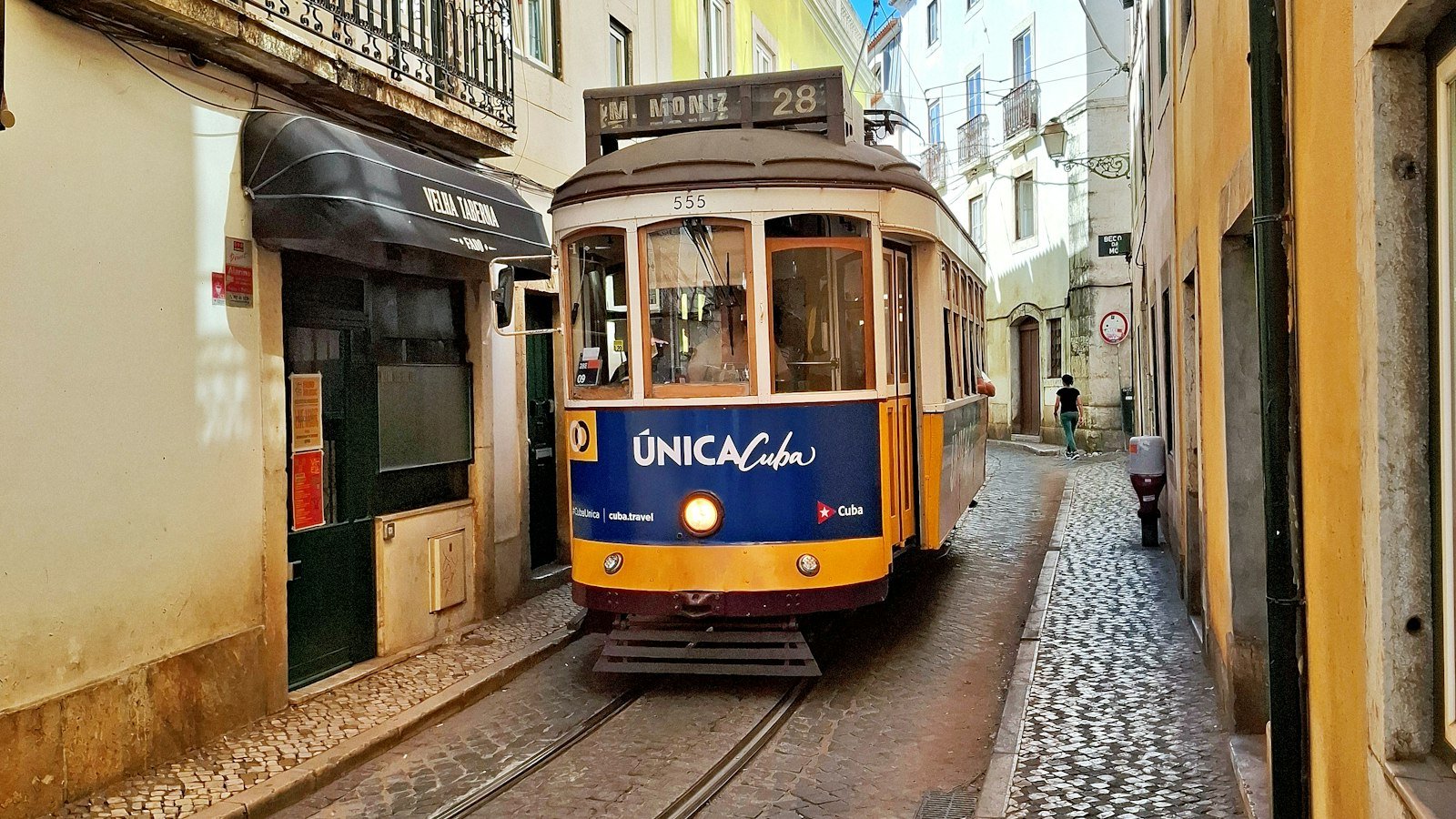
Five minutes downhill from the castle gate is Miradouro de Santa Luzia, the terrace with the bougainvillea and tiled panels, and two minutes further is Miradouro das Portas do Sol, looking straight down over Alfama’s rooftops to the river. Both are free. This is where the Tram 28 photographs are taken; the tram itself is rammed by 10 am, so if you want to ride it, do it once, early, from the Martim Moniz end, with your phone in a front pocket.
11:15 am: Alfama on foot, then the National Pantheon
Drop into the lanes below Portas do Sol without a route. Alfama survived the 1755 earthquake, which is why it has no straight streets; get slightly lost for 45 minutes, aiming east, and you reach the white dome of the National Pantheon. Entry is €8 (about $9 / £7) and the reason to go in is the roof terrace. Closed Mondays.
12:45 pm: lunch in Alfama
Alfama’s restaurants on the main tourist lanes are overpriced, so pick with care. Miss Can, a small place doing Portuguese tinned fish with bread and salad, is cheap and quick. Or walk ten minutes down to Baixa for a bifana, the pork sandwich, at the counter of As Bifanas do Afonso near Rossio or O Trevo in Chiado.
2:15 pm: Praça do Comércio and the Baixa grid
From Alfama it is a 15-minute, mostly downhill walk along the river to Praça do Comércio, the huge yellow square that was the city’s front door when people arrived by ship. Go through the Arco da Rua Augusta and up the pedestrian Rua Augusta to Rossio. This is the flat part of the day.
You will pass the Santa Justa lift, the iron tower linking Baixa to Chiado. As of October 2026 it is closed, and has been since 3 September 2025, when the Glória funicular derailed and Carris suspended all four of its historic lifts. No reopening date is confirmed. The walk up to Chiado via Rua do Carmo takes ten minutes and is not steep.
3:30 pm: Carmo Convent
At the top of that walk is the Carmo Convent, the Gothic church whose roof fell in during the 1755 earthquake and was never rebuilt. The bare arches against the sky are the most memorable image of the disaster, and the small museum behind the nave is worth 20 minutes. Tickets are €7 (about $8 / £6) at the door only. It opens Monday to Saturday from 10 am, until 7 pm from May to October and 6 pm from November to April, last entry 20 minutes before. Closed Sundays.
4:30 pm: Chiado’s cafés and the walk to Príncipe Real
Chiado is the old literary quarter: A Brasileira, the café with the bronze Fernando Pessoa outside, and Livraria Bertrand, the bookshop on Rua Garrett. Manteigaria, on Praça Luís de Camões, makes the pastel de nata many residents prefer to the famous one in Belém; find out which side you are on. Then walk 15 minutes uphill through the edge of Bairro Alto to the garden at Príncipe Real, where the wine bars and restaurants are.
6:30 pm: sunset at Miradouro de São Pedro de Alcântara
Walk back down to the terrace at São Pedro de Alcântara, which faces east across the valley to the castle, lit orange at this hour. Older guides send you up on the Glória funicular from Restauradores; that is the one that crashed in September 2025 and it remains out of service, with bus 51E as the replacement. Dinner: Cervejaria Ramiro for seafood if you want the classic Lisbon night out, booked well ahead. Otherwise eat in Príncipe Real or Bairro Alto, which is lively from 10 pm and noisy until 3 am.
Day 2: Belém, then the riverfront back to Chiado
Belém, six kilometres west of the centre, holds the two monuments every visitor sees: the Jerónimos Monastery and the Belém Tower. Both close on Mondays, both open at 9:30 am, and both have the longest queues in Lisbon by midday. Be there before they open, do them back to back, and be at lunch when the tour buses arrive.
8:30 am: Pastéis de Belém
Get to Belém on the 15E tram from Praça da Figueira (about 30 minutes) or the train from Cais do Sodré (under 15 minutes, then a short walk); both are covered by a 24-hour Navegante ticket. Go straight to Pastéis de Belém, home of the original custard tart, open from 8:00 am. There are two queues: the takeaway counter at the front, long from late morning, and the table rooms behind it through a separate door, which seat you much faster. At 8:30 am there is usually no queue at either. Eat two warm, with cinnamon.
9:30 am: Jerónimos Monastery
Cross the road and be at the cloister entrance for 9:30 am opening. The standard ticket is €18 (about $21 / £16) as of October 2026, reduced for under-25s and over-65s, free under 12. The Museus e Monumentos de Portugal site links to the online ticket office, and booking there lets you walk past a ticket queue that can reach an hour in summer. The cloister is open Tuesday to Sunday, 9:30 am to 5:30 pm, last entry 5:00 pm. The two-storey Manueline cloister is why the building is a World Heritage Site; allow an hour. The church next door, where Vasco da Gama and the poet Camões are buried, is free with its own queue, and opens at 10:30 am Tuesday to Saturday and only at 2 pm on Sundays, so do the cloister first.
11:30 am: the riverfront to the Belém Tower (book a timed slot)
Take the underpass to the river and walk west along the promenade, past the Monument to the Discoveries and its compass-rose mosaic (free, ten minutes), to the tower, another ten minutes on. The Belém Tower reopened on 27 May 2026 after more than a year of restoration, with a new entry system: timed slots, 60 people every half hour, 900 visitors a day. That is far fewer than before, so in summer you book your slot online days ahead. Adult entry is €15 (about $17 / £13) as of October 2026, children under 12 free; open Tuesday to Sunday, 9:30 am to 5:30 pm, last entry 5:00 pm. Inside is a narrow spiral staircase and a few bare rooms; the point is the top terrace with the river on three sides. If the slots are gone, the exterior and the promenade are free and that is where most photographs are taken anyway.
1:15 pm: lunch in Belém, or save it for LX Factory
Belém’s lunch spots are adequate and forgettable. Better to get back on the 15E eastbound to LX Factory in Alcântara, 15 to 30 minutes depending on where you board: a former textile works under the 25 de Abril bridge, now restaurants, the Ler Devagar bookshop and weekend markets. Eat there, then wander for an hour.
3:30 pm: Cais do Sodré and the Time Out Market
Tram or train on to Cais do Sodré. The Time Out Market in the old Mercado da Ribeira is a hall of counters run by well-known Lisbon chefs; at lunchtime it is a scramble for tables, mid-afternoon it is calm and works as a tasting stop.
5:00 pm: up to Chiado for the evening
The Bica funicular, which climbed from near Cais do Sodré towards Bairro Alto, is another lift closed since September 2025; bus 22B replaces it, or the walk up Rua da Bica takes five to seven minutes. Finish with a rooftop drink: the terrace bar at the Bairro Alto Hotel is open to non-guests and has the best dusk view across the river. If you would rather sleep near the evening action, LX Boutique Hotel by Cais do Sodré station is the reliable mid-range choice; ask for a courtyard-facing room.
Day 3: Sintra and Pena Palace
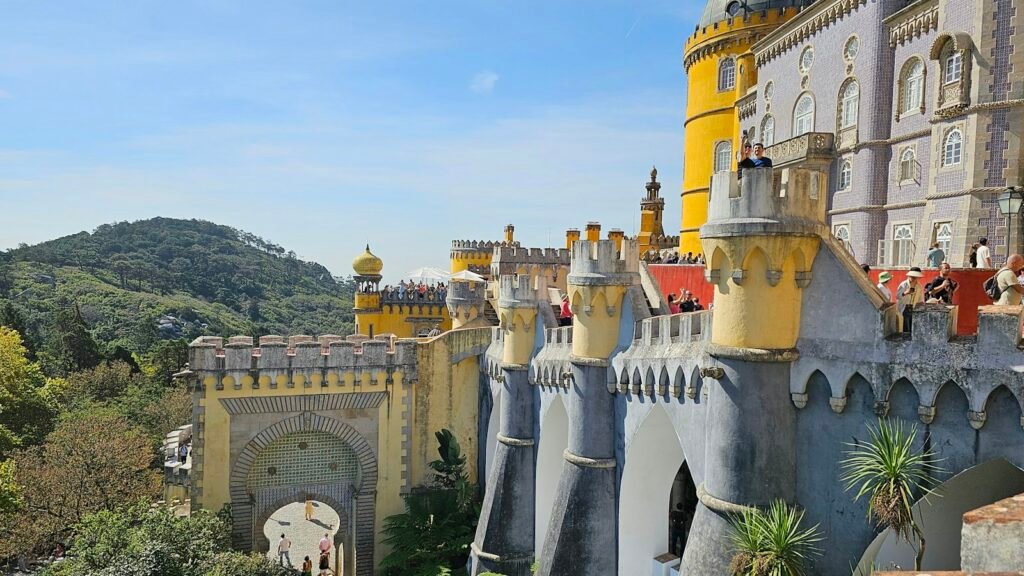
Sintra is the day trip everyone takes and most people do badly, arriving at 11 am to find Pena sold out and the bus queue round the block. The fix: an early train, a timed Pena ticket already on your phone, and the hilltop sights before the town. The train is cheap and frequent, so skip the coach tour.
8:00 am: train from Rossio
CP trains leave Rossio for Sintra every 15 to 30 minutes and take about 40 minutes. A single is €2.45 (about $2.90 / £2.10) loaded on to your Navegante card. The ordinary €7.25 day ticket does not cover this line; the €11.40 Carris/Metro/CP 24-hour ticket and the Lisboa Card do. Aim for a train between 7:30 and 8:15 am.
8:50 am: bus 434 to the top
Outside the station, the Scotturb 434 runs a one-way loop: station, Moorish Castle, Pena Palace, historic centre, station. A 24-hour ticket for Sintra’s buses was €10.96 (about $13 / £9.50) when we checked in October 2026. The ride to Pena takes 30 minutes or more in traffic. Walking up takes about 50 minutes on a steep forest road; fine on the way down, a mistake on the way up.
9:30 am: Pena Palace
The palace opens at 9:30 am and the park at 9:00 am. Palace tickets are sold for a specific date and time and you are admitted only then, so book the first morning slot through Parques de Sintra, the official operator, before you travel. The Essential Visit, covering the state rooms, the terraces and the park, is €20 (about $23 / £17) for adults as of October 2026, €18 for ages 6 to 17 and over-65s, €65 for a family of four. Park only is €12. The €45 Complete Visit adds the private apartments; not necessary on a first trip. Do the terraces first, then the interior, then walk down through the park. Fog often sits on the ridge until 10 or 11 am; if you arrive in cloud, see the rooms first and come back out. Last palace admission is 6:00 pm; the park closes at 7:00 pm.
11:30 am: Castelo dos Mouros
The Moorish Castle is about 400 metres from the Pena entrance and costs €12 (about $14 / £10). It is a ring of walls along the ridge rather than a building, all steps and views, including the one back to Pena that you cannot get from Pena itself. Allow an hour. Short on energy, this is the stop to drop.
1:00 pm: lunch in Sintra town
Take the 434 down to the Sintra Vila stop, 15 minutes. There is almost nothing to eat on the hilltop, so lunch waits for the town. Piriquita, the pastry shop by the square, makes the travesseiro, a pillow of puff pastry and almond cream that is Sintra’s answer to the pastel de nata.
2:30 pm: Quinta da Regaleira
Ten minutes’ walk from the square, Quinta da Regaleira is the estate with the spiral Initiation Well, the grottoes and the tunnels that most visitors end up liking more than Pena. Entry is €20 (about $23 / £17), booked ahead. It is busiest in late morning, which is why it sits in the afternoon here; the queue for the well is shortest after 3 pm. Allow 80 minutes.
4:30 pm: back to Lisbon
Walk the 20 minutes back to the station; buses and ride-hails are slow in the late afternoon. You will be at Rossio around 5:30 pm. For the last evening, book a fado house in Alfama; the serious ones take reservations and start around 8 or 9 pm. A room at Memmo Alfama means you walk home afterwards.
Getting around Lisbon in 2026: fares, closures and the Lisboa Card
Lisbon’s transport is cheap and the fares all live on one card. Buy a Navegante card for €0.50 at any metro machine and load either a 24-hour ticket or “zapping” credit, which charges per ride. Each person needs their own card. Metro gates also take contactless bank cards as of 2026, at €1.92 a ride. These are the Carris fares for 2026, shared with Metro de Lisboa:
| Fare (2026) | Price | Roughly in USD / GBP |
|---|---|---|
| Navegante card (one-off) | €0.50 | $0.60 / £0.45 |
| Metro single ticket | €1.90 | $2.20 / £1.65 |
| Zapping fare per ride (metro, bus, tram) | €1.72 | $2.00 / £1.50 |
| 24-hour ticket, Carris + Metro | €7.25 | $8.50 / £6.25 |
| 24-hour ticket, Carris + Metro + CP trains (Sintra, Cascais) | €11.40 | $13.30 / £9.80 |
| Tram single bought on board | €3.30 | $3.85 / £2.85 |
| Bus single bought on board | €2.30 | $2.70 / £2.00 |
| Rossio to Sintra train, single | €2.45 | $2.90 / £2.10 |
| Sintra bus 434, 24-hour ticket | €10.96 | $12.80 / £9.45 |
The lifts and funiculars. This is the part of Lisbon that changed. On 3 September 2025 the Glória funicular derailed on its way down to Restauradores, killing 16 people, and Carris suspended its other historic machines: the Bica and Lavra funiculars and the Santa Justa lift. As of October 2026 all four remain closed with no confirmed reopening dates, and Portuguese press reports put Bica and Lavra years away. Replacement buses: 51E for Glória, 22B for Bica, 19B for Lavra. The exception is the Graça funicular, which reopened on 30 April 2026. Any guide that tells you to ride Santa Justa or Glória is out of date.
Is the Lisboa Card worth it? The official pass from Visit Lisboa bundles unlimited transport, Sintra train included, with free entry to more than 50 sites; the 72-hour adult card was €62 (about $72 / £53) in October 2026. Against this itinerary, separate transport is about €26, plus castle €17, Jerónimos €18, Belém Tower €15 and Pantheon €8: €84, so the card saves around €20 if you do all of them. Caveats: the Sintra palaces are discounted, not free, several museums were flagged as closed for restoration on the inclusions list when we checked, and Jerónimos requires advance booking with your card number.
Tourist tax, airport transfers and what hotels cost
Tourist tax. Lisbon charges €4 per person per night (about $4.70 / £3.45), capped at seven nights, so three nights adds €12 per adult. Under-13s are exempt and the charge applies to hotels and short-term rentals alike. The rate is set by the Câmara Municipal de Lisboa and stays at €4 in the 2026 fee schedule. Some booking sites include it in the total; others leave the hotel to collect it at check-in.
Airport to the centre. The metro red line starts at the airport and runs 6:30 am to 1 am; a single is €1.90 on a €0.50 Navegante card, changing at Alameda for the green line to Baixa-Chiado. Allow 30 to 35 minutes. A taxi to Baixa is typically €15 to €20 plus a flat €1.60 luggage charge, about 20 per cent more at night and weekends. Uber and Bolt usually come in around €10. The Aerobus was withdrawn in 2022.
Hotels. For a central three- or four-star double in spring or autumn, budget €120 to €200 a night (about $140 to $235 / £105 to £170); in October 2026 the comparison sites put the four-star average near $250, with January cheapest and September dearest. Small boutique places sell out first, so for April to October book two to three months ahead; the breakdown by neighbourhood is in our Lisbon where-to-stay guide. To sleep in Belém and start Day 2 without the tram ride, Jerónimos 8 is a minute’s walk from the monastery.
What we’d change
Two days only: drop Sintra. Lisbon in two days with a half-day trip bolted on means doing all three badly. Do Day 1 as written, Day 2 to the Belém Tower slot, then the Time Out Market and Chiado.
Four days: add a slow one. Morning at the Calouste Gulbenkian Museum, the best art collection in the country and almost no queue, then the ferry from Cais do Sodré to Cacilhas for grilled fish with the skyline in front of you.
July or August: flip Day 2 so the tower slot comes first at 9:30 am and the monastery after 3 pm when its queue thins. In Sintra, book Pena’s first slot and skip the Moorish Castle, which has no shade.
FAQ
Is three days enough for Lisbon?
Yes, if one of them is Sintra. Two full days cover the castle hill, Alfama, Baixa, Chiado and Belém without rushing. A fourth lets you add the Gulbenkian or a beach at Cascais.
Which tickets do I really need to book in advance?
Pena Palace, because entry is at a fixed time and morning slots sell out days ahead in summer. Belém Tower, because the 900-a-day cap means walk-ups are often turned away. The castle and Jerónimos can be bought on the day at opening, but booking online costs nothing extra and removes the ticket queue.
Is the Santa Justa lift open?
No. It has been closed since 3 September 2025, along with the Glória, Bica and Lavra funiculars, following the Glória derailment. Only the Graça funicular has reopened. Check carris.pt for the current status before you go, and plan on walking or taking the replacement buses.
Should I do Sintra on a tour or by train?
By train. Rossio to Sintra is €2.45 each way, about 40 minutes, every 15 to 30 minutes; the 434 bus does the hill. A tour only earns its price if you want to add the coast (Cabo da Roca, Cascais) in the same day, which this plan deliberately does not.
How we researched this: opening hours, ticket prices and fares were checked in October 2026 against the official sites of Castelo de São Jorge, Museus e Monumentos de Portugal, Parques de Sintra, Carris, Metro de Lisboa and Visit Lisboa, Lisbon’s municipal tourist-tax schedule, Portuguese press reports on the funicular closures and the Belém Tower reopening, current hotel rates on major booking sites, and recent itineraries from independent Lisbon-based writers. Prices and closures change; confirm before you travel.
Leave a Reply