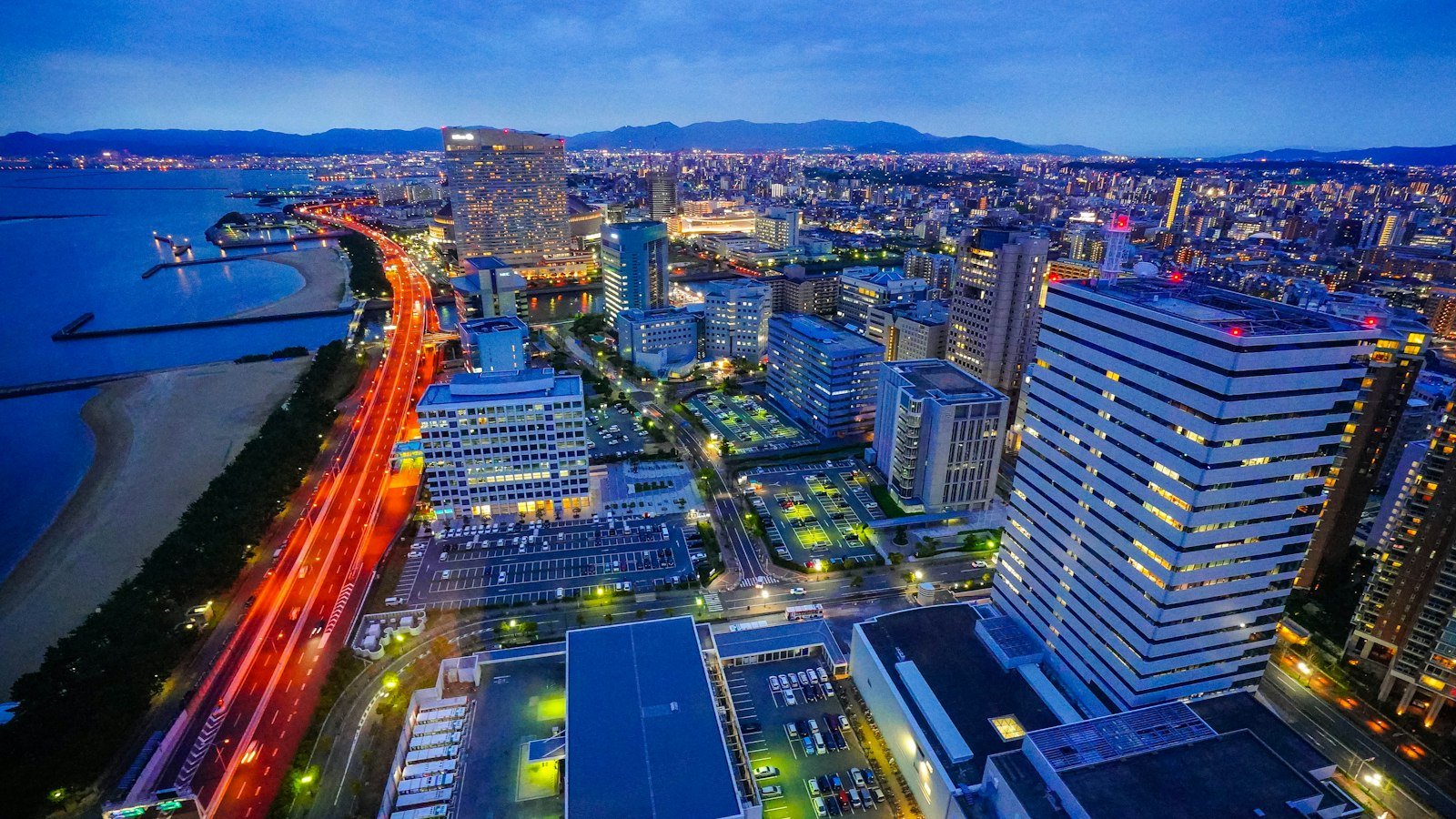
Last updated: 9 November 2026. This guide contains affiliate links; if you book through one we may earn a commission at no extra cost to you. How we make money.
Short answer: Fukuoka gives you a big Japanese city, some of the country’s best cheap food and a beach-side skyline for noticeably less than Tokyo, Kyoto or Osaka. A good mid-range double here typically runs ¥8,000–¥13,000 a night, against ¥12,000–¥18,000 for the same class of room in Tokyo or Kyoto. The airport is five minutes from the main station by subway, which no other major Japanese city can match. Stay in Hakata if you plan day trips by train, Tenjin if you care more about shopping and evenings, and give it at least two full days, plus one for Dazaifu.
In this guide
- Why Fukuoka is Japan’s best-value city
- Where to stay: Hakata vs Tenjin vs Nakasu
- What to eat, and what it costs
- What to see in the city
- Day trips: Dazaifu and the islands
- Airport, transport and tourist tax
- When to go (and when hotels spike)
- FAQ
Why Fukuoka is Japan’s best-value city
Fukuoka is the largest city on Kyushu, Japan’s southern main island, and most first-time visitors skip it because it is not on the Tokyo–Kyoto–Osaka line. That is exactly why it is good value. Hotels are priced for domestic business travellers rather than international tour groups, and the food that made the city famous, tonkotsu ramen and the open-air yatai stalls, is cheap by design.
Here is how typical hotel rates compare across the four cities most people are choosing between. These are per room, per night, in a normal (not peak) week.
| City | Budget / business hotel | Mid-range | Luxury (entry price) | Mid-range in USD / GBP |
|---|---|---|---|---|
| Fukuoka | ¥5,500–¥8,500 | ¥8,000–¥13,000 | ¥24,000+ | $51–$82 / £38–£61 |
| Osaka | ¥6,000–¥9,000 | ¥10,000–¥15,000 | ¥28,000+ | $63–$95 / £47–£71 |
| Tokyo | ¥7,000–¥10,000 | ¥12,000–¥18,000 | ¥35,000+ | $76–$114 / £57–£85 |
| Kyoto | ¥7,000–¥10,000 | ¥12,000–¥18,000 | ¥35,000+ | $76–$114 / £57–£85 |
The gap widens at the top. A luxury room in Fukuoka starts around a third cheaper than in Tokyo or Kyoto. Add a modest tourist tax, a ¥640 day pass that covers the whole subway network, and yatai dinners from around ¥1,500, and the savings add up quickly over a three- or four-night stay. If you are building a wider Japan trip, our guides to Tokyo, Kyoto and Osaka cover the other bases.
Where to stay: Hakata vs Tenjin vs Nakasu
Fukuoka’s centre is compact. Hakata Station and Tenjin are about 2 km apart, two stops on the same subway line, with the river island of Nakasu in between. You cannot pick a truly bad base among these three. The question is whether your trip leans towards trains or towards evenings.
Hakata: best for day trips and short stays
Hakata Station is where the shinkansen, the JR lines, the airport subway and the main bus terminal meet. It has the densest cluster of hotels in the city and the strongest choice of hotel breakfasts. If you are arriving by bullet train, leaving early for Dazaifu or Nagasaki, or only staying two nights, this is our pick. The trade-off: the station area is practical rather than pretty, and it goes quiet at night compared with Tenjin.
- Budget: the b hakata – four to six minutes’ walk south of the Chikushi exit, with free snacks in the lobby in the afternoon and a 24-hour Matsuya on the ground floor. Rooms are small (around 15 m² for a double). Roughly ¥7,000–¥12,000 off-peak.
- Splurge: Miyako Hotel Hakata – linked to the station from the basement, with rooms of 30 m² and up and a rooftop natural hot-spring bath. Around ¥25,000–¥35,000 off-peak.
Tenjin and Daimyo: best for shopping, cafés and nightlife
Tenjin is the commercial centre: department stores, a kilometre of underground shopping arcade, and the Nishitetsu station for trains to Dazaifu. Daimyo, a few minutes’ walk west, is the café and bar district where the city’s younger crowd goes out. Choose this side if you would rather walk out of your hotel into dinner than onto a train. The trade-off: “Tenjin” is really three separate stations on different lines, which confuses people on day one, and JR day trips mean heading back to Hakata first.
- Mid-range: Hotel Monterey La Soeur Fukuoka – 191 rooms with hardwood floors on the edge of Daimyo, and a breakfast buffet. Roughly ¥13,000–¥35,000.
- Upper mid-range: Solaria Nishitetsu Hotel Fukuoka – built into the Nishitetsu Fukuoka (Tenjin) station complex, so Dazaifu is a lift ride and a train away. Breakfast is served on the 17th floor. Roughly ¥16,000–¥55,000.
Nakasu and Gion: best for yatai and the old town
Nakasu is the island between the two centres, Fukuoka’s entertainment district, and the place where the riverside food stalls set up each evening. Staying here puts you on the subway (Nakasu-Kawabata station) and within a short walk of both Canal City and the yatai. Gion, just east, is calmer and closer to Kushida Shrine and the older temple streets. The trade-off: Nakasu is busy and loud late into the night, which suits couples and groups far better than families wanting an early night.
- Mid-range: Hotel Vista Fukuoka Nakasu Kawabata – opened in 2019, about three minutes from Nakasu-Kawabata station and around ten minutes’ walk from the yatai, with a large shared bath. Roughly ¥10,000–¥30,000.
- Quieter option: Mitsui Garden Hotel Fukuoka Gion – about five minutes from Gion station and seven from JR Hakata, with a large public bath including an open-air rooftop bath.
Our pick: for a first visit of two or three nights, Hakata. You will use the station more than you expect, and Tenjin is a few minutes away by subway when you want it. Skip Momochi (the seaside district around Fukuoka Tower) as a base unless you are there for a concert at the dome; it is lovely to visit but awkward for everything else.
What to eat, and what it costs
Food is the reason most Japanese travellers come to Fukuoka, and it is where the city’s value shows most clearly.
Yatai. Fukuoka has around 100 open-air food stalls, clustered in Nakasu along the Naka River, on the pavements around Tenjin, and a handful in Nagahama by the old fish market. They open from about 6 pm, usually close one night a week, and stay shut in heavy rain or wind. Seating is a bench at the counter, so you will be sitting shoulder to shoulder with locals. Expect a one-drink-per-person rule and bring cash. The official Fukuoka tourism site lists current stalls and etiquette.
Our advice: skip the Nakasu riverfront stalls on your first night if there is a queue, and try the Tenjin ones instead. They are less photographed, the queues are shorter, and the food is the same standard.
Hakata ramen. This is the home of tonkotsu: a cloudy broth from pork bones boiled for many hours, with thin, straight noodles. You choose how firm you want the noodles (kata is firm, futsuu is regular, yawa is soft) and ask for kaedama, a second portion of noodles, when you have finished the first. Canal City’s Ramen Stadium reopened in April 2026 with eight shops on the fifth floor.
Motsunabe and mentaiko. Motsunabe is a hotpot of beef or pork offal with cabbage and garlic chives, best in winter. Mentaiko, spicy marinated fish roe, is the city’s signature ingredient, and turns up in omelettes, gyoza and on rice.
| Dish | Typical price | Roughly in USD / GBP |
|---|---|---|
| Bowl of Hakata ramen (yatai) | ¥800–¥1,200 | $5–$8 / £4–£6 |
| Extra noodles (kaedama) | ¥150–¥200 | $1 / under £1 |
| Yakitori, per skewer | ¥150–¥300 | $1–$2 / £1–£1.50 |
| Motsunabe (yatai portion) | ¥900–¥1,400 | $6–$9 / £4–£7 |
| Draft beer | ¥500–¥600 | $3–$4 / £2.50–£3 |
| Full yatai meal with a drink | ¥1,500–¥3,000 | $10–$19 / £7–£14 |
What to see in the city
Fukuoka is not a city of big-ticket sights, which is part of why it is cheap. Most of what is worth seeing is free.
- Kushida Shrine – Hakata’s guardian shrine, about ten minutes’ walk from Hakata Station, and the home of the Hakata Gion Yamakasa festival. Free; gates open 4 am to 10 pm.
- Ohori Park – a large lake park, two subway stops west of Tenjin. The Japanese Garden costs ¥250 for adults and closes on Mondays; the Fukuoka Art Museum’s collection galleries are ¥200.
- Canal City Hakata – a shopping and entertainment complex built around an artificial canal, with the Ramen Stadium upstairs. Shops 10 am to 9 pm, restaurants until 11 pm.
- Fukuoka Tower and Momochi beach – the tower by the sea is the best place to watch the sun go down over Hakata Bay. Entry is ¥1,000, open 9:30 am to 10 pm (last entry 9:30 pm). Walk the beach first, go up at dusk.
Day trips: Dazaifu and the islands
Dazaifu Tenmangu is the day trip everyone takes, and it deserves it. The shrine sits at the end of a shop-lined approach street that is half the reason to go. Take the Nishitetsu line from Nishitetsu Fukuoka (Tenjin) station, changing at Futsukaichi; allow 30–35 minutes. Entry to the shrine grounds is free. Go early on a weekday: by late morning on weekends the approach is shoulder to shoulder.
Nokonoshima is a small island in Hakata Bay with a flower park, Nokonoshima Island Park. The ferry from Meinohama takes about ten minutes and costs ¥230; Island Park entry is ¥1,500. It is a good half day in spring or autumn, less so in the heat of August.
Uminonakamichi Seaside Park, across the bay, is a large waterfront park and a good alternative if the ferry timings do not suit. Entry is ¥450; it is open 9:30 am to 5:30 pm from March to October and closes at 5 pm in winter.
Airport, transport and tourist tax
Airport to the centre. Fukuoka Airport’s domestic terminal has its own subway station. Hakata Station is about five minutes away and Tenjin about eleven, with trains every four to eight minutes, for around ¥260 ($1.65 / £1.25). If you land at the international terminal, a free shuttle bus takes about ten minutes to the domestic terminal; allow roughly 30 minutes door to platform in total. A taxi to Hakata is roughly ¥1,800–¥2,500 and takes 10–15 minutes; to Tenjin, around ¥2,500–¥3,500.
Getting around. The Fukuoka City Subway one-day pass costs ¥640 for adults (about $4 / £3) and covers all three lines, including the airport. Suica, ICOCA, PASMO and the local Hayakaken and SUGOCA cards all work. Note that the subway is not JR, so the Japan Rail Pass does not cover it.
Tourist tax. Fukuoka City charges an accommodation tax of ¥200 per person per night on rooms under ¥20,000 per person, and ¥500 at ¥20,000 or more; ¥50 of each goes to the prefecture (Fukuoka City tax leaflet). It is calculated on the room charge only, excluding meals, and most hotels collect it at check-in rather than including it in your online total. Elsewhere in Fukuoka Prefecture the rate is a flat ¥200.
Safety. Fukuoka is one of the safest big cities you will visit. The one habit worth keeping is in Nakasu late at night: choose bars yourself rather than following anyone who approaches you on the street.
When to go (and when hotels spike)
Spring (March to May) and autumn (October to November) are the most comfortable months. Winter is the season for motsunabe and steaming yatai oden; summer is hot and humid, and stormy weather closes the stalls.
Three periods push hotel prices up sharply. Golden Week (late April to early May) overlaps with the Hakata Dontaku festival, which draws more than two million visitors. The Hakata Gion Yamakasa runs from 1 to 15 July, ending with the dawn float race that starts at 4:59 am on the 15th. Big concerts and events at the dome can also tighten availability for a weekend, so check the calendar before you commit. If your dates touch any of these, book three months or more ahead. For the rest of the year, four to six weeks is usually enough. Planning a spring trip? Our Japan cherry blossom 2027 guide covers bloom timing and where to stay.
FAQ
How many days do I need in Fukuoka?
Two full days covers the city and a yatai night each evening. Add a third for Dazaifu, or a fourth if you want Nokonoshima or a slower pace.
Is Hakata or Tenjin better for a first visit?
Hakata, if you will take any trains out of the city. Tenjin, if your trip is mostly about eating, shopping and evenings. They are a few minutes apart by subway, so the choice matters less than in Tokyo or Osaka.
Is Fukuoka really cheaper than Osaka?
For hotels, yes, by a modest margin at mid-range (about ¥2,000 a night on typical rates) and more at the luxury end. Food costs are similar; Fukuoka simply has more cheap places to eat well.
Do I need cash for the yatai?
Yes. Most stalls are cash only. ¥3,000–¥5,000 per person covers a relaxed evening with a couple of drinks.
Can I use Fukuoka as a base for the rest of Kyushu?
Yes. Hakata Station is Kyushu’s main rail hub, with shinkansen services south and JR lines across the island. Stay near the station and day trips become simple.
How we researched this: hotel locations, facilities and price ranges, food prices, opening hours and transport details were cross-checked in November 2026 against the Fukuoka City accommodation-tax leaflet, Fukuoka City Subway fare pages, the official Fukuoka tourism site, hotel-chain tax notices, current rates on major booking sites and recent independent Japan travel guides. Prices move, especially around festivals; always confirm before you book.
Leave a Reply