Last updated: 5 November 2026. This guide contains affiliate links; if you book through one we may earn a commission at no extra cost to you. How we make money.
Short answer: on a first trip to Osaka, stay in Namba, within five minutes of Namba station. You are on the Midosuji subway line, one train from Kansai Airport, one train from Nara, and a short walk from Dotonbori, which is the reason most people come. Pick Umeda instead if you plan several day trips to Kyoto and Kobe, and Honmachi if you want a quiet, cheaper room halfway between the two. Shinsekai is a fun evening out; it is not where we would sleep on a first visit.
Quick answer: where to stay in Osaka
| If you are… | Stay in | Our top pick |
|---|---|---|
| A first-time visitor | Namba & Dotonbori | Cross Hotel Osaka |
| Doing day trips to Kyoto, Kobe or Nara | Umeda (Kita) | Hotel Hankyu Respire Osaka |
| A light sleeper on a budget | Honmachi & Yodoyabashi | Hotel Cordia Osaka Hommachi |
| After space and value | Tennoji & Shinsekai | OMO7 Osaka by Hoshino Resorts |
| A family going to Universal Studios | Universal City | The Park Front Hotel at Universal Studios Japan |
In this guide
- Osaka neighbourhoods compared
- Namba & Dotonbori: best for first-timers
- Shinsaibashi: best for shoppers who want Namba without the canal noise
- Umeda: best for day trips and rail connections
- Honmachi & Yodoyabashi: best for quiet nights and value
- Tennoji & Shinsekai: best for budget and big rooms
- Universal City & the Bay: best for theme-park families
- Areas to think twice about
- What Osaka hotels cost in 2026
- Accommodation tax, airport transfers and getting around
- FAQ
Osaka neighbourhoods compared
Osaka is flat, compact and run on one spine: the Midosuji subway line, which runs north to south through Shin-Osaka, Umeda, Honmachi, Shinsaibashi, Namba and Tennoji. If your hotel is a few minutes from a Midosuji station, you can reach almost everything a first-timer wants in under 15 minutes. The real choice is between Minami (the south: Namba, Dotonbori, Shinsaibashi), which is loud, cheap to eat in and open late, and Kita (the north: Umeda), which is a business and rail hub that goes quiet after ten.
| Area | Best for | Hills / walkability | Night noise | Transport | Mid-range price |
|---|---|---|---|---|---|
| Namba & Dotonbori | First trip, food, nightlife | Flat, very walkable | High near the canal | Midosuji, Sennichimae, Yotsubashi; Nankai to the airport; Kintetsu to Nara | ¥19,000–¥44,000 |
| Shinsaibashi | Shopping, a slightly calmer Minami | Flat | Medium | Midosuji, Nagahori Tsurumi-ryokuchi; one stop to Namba | ¥17,000–¥30,000 |
| Umeda (Kita) | Day trips, rail, department stores | Flat, but a confusing underground maze | Low | JR Osaka, Hankyu, Hanshin, three subway lines | ¥23,000–¥40,000 |
| Honmachi & Yodoyabashi | Quiet nights, value, business trips | Flat | Very low | Midosuji, Chuo, Yotsubashi; Keihan to Kyoto | ¥19,000–¥30,000 |
| Tennoji & Shinsekai | Budget, bigger rooms, Haruka to the airport | Flat | Medium around Shinsekai | Midosuji, JR Loop, JR Haruka, Kintetsu | Generally below Namba |
| Universal City & the Bay | Universal Studios Japan | Flat | Very low | JR Yumesaki line; about 20 min to the centre | From about ¥21,000 |
Namba & Dotonbori: best for first-timers
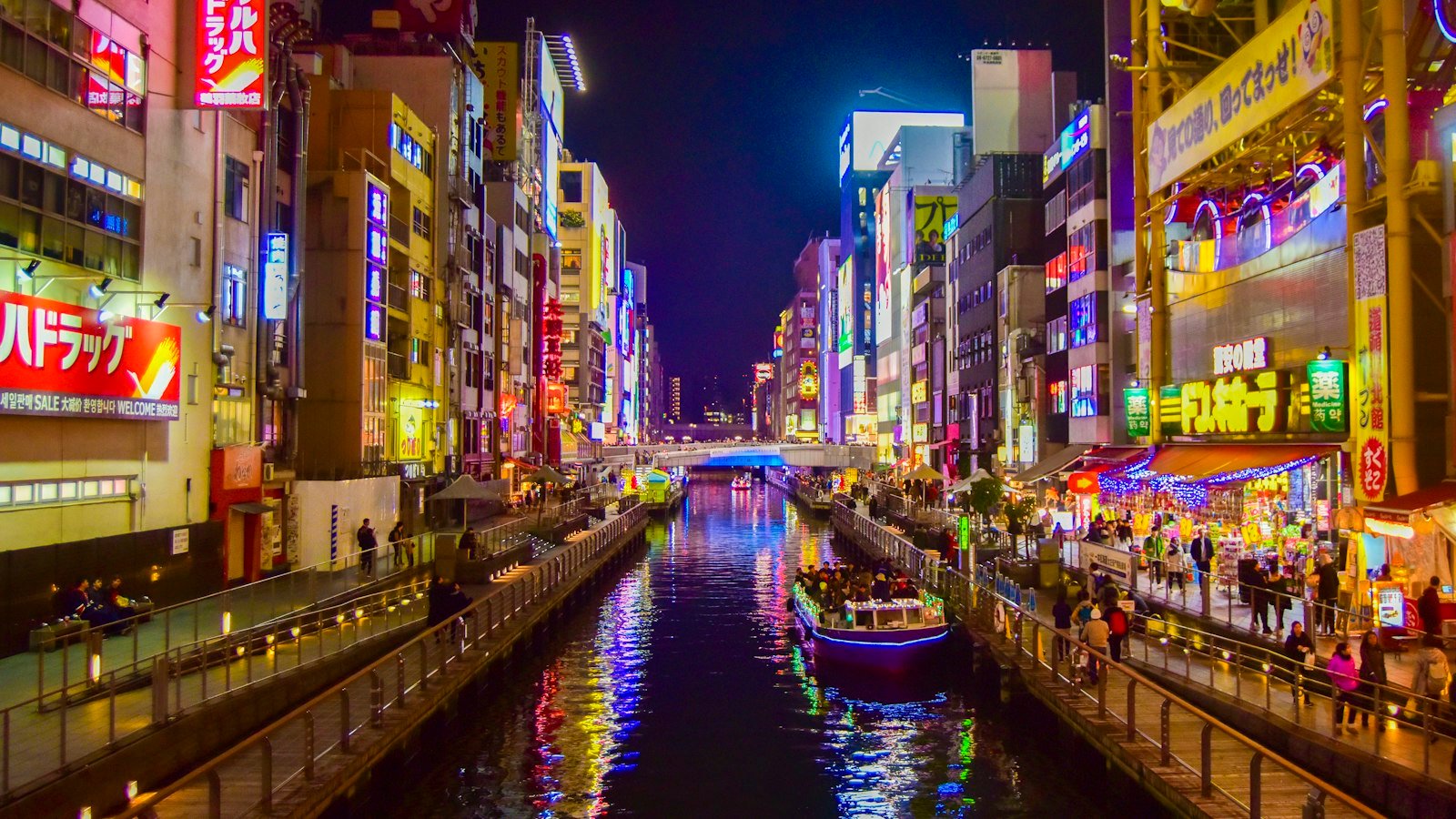
Namba is the Osaka of the postcards: the Glico running man, the neon-stacked Dotonbori canal, Kuromon Market and the lantern-lit alley of Hozenji Yokocho. It is also the most practical base in the city. The Nankai line runs from Namba straight to Kansai Airport, the Kintetsu line goes to Nara without a change, and the Midosuji subway takes you north to Umeda in under ten minutes.
The trade-off: it is never truly quiet, rooms are small, and prices run a little above the rest of the city. Ask for a high floor on the side away from the canal, and do not book a hotel that only says “near Namba”; Namba is a cluster of separate stations, and the walk between the JR and Nankai ends is longer than it looks. Touts work the Dotonbori side streets at night; a polite no is enough. It is still the right first base for most people.
Our picks:
- Budget: Hiyori Hotel Osaka Namba Station – about 200 metres from the station, with compact 16 m² rooms and 21 m² twins. A sensible choice if you are out all day and want to be close to the airport train.
- Mid-range: Cross Hotel Osaka – two minutes from Dotonbori and three from Namba subway station, with rooms of 24–27 m², which is generous for this part of town. One 2026 guide lists it at roughly ¥12,000–¥18,000 ($76–$114 / £56–£85) a night, though peak dates go well above that.
- Splurge: Centara Grand Hotel Osaka – a five-star tower a four-minute walk from Nankai Namba, rated 9.1 on Booking.com, with rooms from the 6th to the 31st floor. Listed from about ¥56,000 ($354 / £263). The Swissotel Nankai, which sits directly on top of the airport train, is the alternative if you want a pool.
Shinsaibashi: best for shoppers who want Namba without the canal noise
Shinsaibashi starts where Dotonbori ends and runs north along a long covered shopping arcade and the department stores of Midosuji boulevard. It is one subway stop or a ten-minute walk from Namba, so you keep all of Minami on your doorstep and give up only the direct airport train.
The trade-off: the arcade itself is crowded from late morning, and some of the cheaper hotels west of Midosuji face onto streets with late bars. For the airport you will either change at Namba or take the limousine bus. In return you usually pay less than in Namba for a similar room, which is why we would book here when Namba prices spike.
Our picks:
- Budget: Shizutetsu Hotel Prezio Osaka Shinsaibashi – rated 9.0 on Booking.com and listed from about ¥17,000 ($107 / £79), one of the best scores at that price in central Osaka.
- Mid-range: Hotel The Flag Shinsaibashi – five minutes from Shinsaibashi station with rooms of 24–28 m². It is popular and often sold out, so book it early or not at all.
See all hotels in Shinsaibashi →
Umeda: best for day trips and rail connections
Umeda, also called Kita, is the area around JR Osaka Station and the Hankyu and Hanshin terminals. It is the best-connected place in western Japan: Kyoto is about 28 minutes away by JR special rapid, Kobe about 20, and Shin-Osaka, where the bullet trains stop, is one or two stops north. Around it are department-store food halls, Grand Front and the Umeda Sky Building.
The trade-off: it has less character than Minami, many restaurants close by 10 pm, and the underground passages linking the stations are famously hard to navigate with luggage. Choose a hotel that is connected to, or within five minutes of, the line you will use most. If you are spending three or more days on trips out of Osaka, this is where we would stay.
Our picks:
- Budget: Aloft Osaka Umeda – rated 9.1 on Booking.com and listed from about ¥23,300 ($148 / £110), which is good value for a branded hotel in Umeda.
- Mid-range: Hotel Hankyu Respire Osaka – opened in March 2025, about four minutes from JR Osaka Station, with rooms from 22 m² and a connection to the Umekita Onsen Ren bathhouse (extra fee). Listed from about ¥29,700 ($188 / £140).
- Splurge: Osaka Station Hotel, Autograph Collection – in the KITTE building at the station, with a Japanese-style bath area of hot pools, cold plunge and sauna. Access to the baths depends on the room type, so check before you book.
Honmachi & Yodoyabashi: best for quiet nights and value
Between Umeda and Shinsaibashi lies Osaka’s office district: Honmachi, Yodoyabashi, Kitahama and, just to the north, the river island of Nakanoshima with its museums and riverside paths. Honmachi station is on three subway lines, so Namba and Umeda are each a few minutes away, and Yodoyabashi and Kitahama have the Keihan line straight to Kyoto. Weekend rates here are often the best in the centre.
The trade-off: it empties after office hours, and restaurant choice on a Sunday evening can be thin. Nobody comes here for the atmosphere. It suits light sleepers, families and anyone who is happy to ride two stops to dinner.
Our picks:
- Budget: Hotel Cordia Osaka Hommachi – rated 9.1 on Booking.com and listed from about ¥19,100 ($121 / £90); basic doubles are around 20 m², with larger rooms available.
- Mid-range: Onyado Nono Osaka Yodoyabashi – the Japanese-style brand from the group behind Dormy Inn, rated 9.0 on Booking.com. Listed from about ¥21,100 ($134 / £99).
- Splurge: The St. Regis Osaka – directly above exit 7 of Honmachi station, with butler service and a rooftop Japanese garden.
Tennoji & Shinsekai: best for budget and big rooms
Tennoji is a major rail hub in the south of the city, with Abeno Harukas, one of Japan’s tallest buildings, on top of the station, the Shitennoji temple and Tennoji Park next door. Across the park, Shinsekai is a retro, slightly scruffy entertainment district around the Tsutenkaku tower, known for deep-fried kushikatsu skewers. The JR Haruka express to Kansai Airport stops at Tennoji in about 30 minutes, and Namba is a few minutes away on the subway.
The trade-off: Shinsekai gets loud and busy on evenings and weekends, and some streets just south of it, around Shin-Imamiya and Nishinari, feel run-down after dark. Stay close to Tennoji station or inside a well-run property and it is a comfortable base that costs less than Namba. We like it best for second visits and longer stays.
Our picks:
- Budget: Hotel Trusty Osaka Abeno – right next to Tennoji station, with a teppanyaki restaurant in the building.
- Mid-range: OMO7 Osaka by Hoshino Resorts – opposite Shin-Imamiya station, set in a 7,600 m² garden, with twin rooms of 28 m² and larger family-friendly rooms. The public bath costs ¥1,000 per person extra. This is the one hotel that makes the Shin-Imamiya side worth considering.
- Splurge: Osaka Marriott Miyako Hotel – on the upper floors of Abeno Harukas, with rooms from 38 m² and some of the best views in the city. One 2026 guide quotes ¥25,000–¥45,000 ($158–$285 / £117–£211).
Universal City & the Bay: best for theme-park families
If Universal Studios Japan is the point of your trip, sleep next to it. The hotels in Universal City are a few minutes’ walk from the gates, so you can be in the queue early and nap at lunchtime.
The trade-off: it is about 20 minutes each way to central Osaka, and the restaurants are mostly in the CityWalk mall and priced for visitors. Book here for the park nights only and move to Namba or Umeda for the rest of the trip.
Our picks:
- Budget: Grand Prince Hotel Osaka Bay – a big bay-side hotel in the Nanko area, rated 8.8 and listed from about ¥21,000 ($133 / £99). It is further from the park than the hotels below, so check how you will get there.
- Mid-range: Hotel Kintetsu Universal City – about five minutes on foot from the park.
- Splurge: The Park Front Hotel at Universal Studios Japan – about two minutes from the entrance, the closest of the official partner hotels.
See all hotels in Universal City →
Areas to think twice about
Shin-Osaka is where the Shinkansen stops, and that is its only argument. It is an office district with very little to do after dark. It works for one night before an early bullet train; for anything longer, Umeda is two stops away and far more pleasant.
Nishinari and the streets south of Shin-Imamiya have the cheapest beds in the city, some from around ¥3,000–¥5,000 a night. Osaka is a safe city and nothing here is dangerous by Western standards, but the area is visibly poorer, some streets are deserted at night, and it is not where we would send a first-timer, especially one travelling alone.
Osaka Castle and Kyobashi are pleasant, green and quiet, and Kyobashi has the Keihan line to Kyoto. The catch is that dinner and nightlife are a train ride away. Fine for repeat visitors; on a first trip you will spend every evening commuting to Namba.
What Osaka hotels cost in 2026
Osaka’s huge supply of business hotels keeps ordinary weeknights reasonable. Prices climb sharply for cherry blossom in late March and early April, Golden Week at the start of May, and on any weekend with a big concert or event. The table below uses prices we found this week.
| Type | Per night (JPY) | Roughly in USD / GBP |
|---|---|---|
| Basic bed or single room, Shin-Imamiya | ¥3,500–¥5,000 | $22–$32 / £16–£23 |
| Chain business hotel (Dormy Inn, Vessel Inn), often with breakfast | ¥7,000–¥12,000 | $44–$76 / £33–£56 |
| Typical mid-range room in Namba | ¥10,000–¥25,000 | $63–$158 / £47–£117 |
| Well-reviewed four-star, central | ¥19,000–¥44,000 | $120–$280 / £89–£208 |
| Five-star | ¥56,000–¥165,000+ | $354–$1,040+ / £263–£773+ |
When to book: for cherry blossom, Golden Week and the Christmas and New Year period, three to six months ahead. The rest of the year, four to eight weeks is usually enough. Most rates on the big booking sites cancel free until a few days before arrival, so book early and check again a month out.
Accommodation tax, airport transfers and getting around
Accommodation tax. Osaka Prefecture raised its accommodation tax on 1 September 2025. It is charged per person per night, banded by the room rate per person: nothing under ¥5,000; ¥200 from ¥5,000 to ¥14,999; ¥400 from ¥15,000 to ¥19,999; and ¥500 at ¥20,000 or more. So a couple in a ¥30,000 room are each at ¥15,000 and pay ¥400 each, ¥800 a night in total. Hotels usually collect it at check-in. The rules are on the Osaka Prefectural Government’s tax page (in Japanese). We could not confirm the full list of exemptions in English, so ask your hotel if you think one applies.
Kansai Airport to the city. For Namba, take the Nankai line: the Rapi:t limited express takes 35–40 minutes and costs ¥1,520 with an e-ticket (¥1,670 on paper), with a reserved seat; the ordinary Airport Express takes 45–50 minutes for ¥970. For Tennoji, Umeda and Shin-Osaka, the JR Haruka reaches Tennoji in about 30 minutes (¥1,820 unreserved) and Shin-Osaka in about 50 (¥2,540 unreserved), and JR West sells discounted one-way Haruka tickets to foreign visitors. The cheaper JR Kansai Airport Rapid takes about 50 minutes to Tennoji (¥1,060) and 70 minutes to Osaka Station (¥1,180). With heavy bags, the airport limousine bus is easier: ¥1,400 to Namba OCAT in about 50 minutes, ¥1,800 to Osaka Station, Shinsaibashi or Universal Studios. A taxi to the centre runs to about ¥15,000 and 50 minutes.
Getting around. The Osaka Metro Enjoy Eco Card gives a day of unlimited subway and city bus travel for ¥820 on weekdays and ¥620 at weekends and on holidays (¥310 for children), and comes with small discounts at about 20 attractions. If you will visit several paid sights in one day, the Osaka Amazing Pass costs ¥3,500 for one day or ¥5,000 for two, covers the subway and the private railways within the city, and includes entry to around 40 attractions; a 28-hour Kansai Airport version at ¥5,300 adds a one-way Nankai ride from the airport to Namba. Both are listed on the official Osaka tourism site. An ICOCA, Suica or Pasmo card works on all trains and buses if you would rather pay as you go.
A safety note. Osaka is one of the safest big cities you will visit, and walking around Namba late at night is normal. The everyday risks are touts in the Dotonbori side streets offering bars with hidden charges, and the ordinary pickpocket risk of very crowded places such as the canal bridges at weekends. Keep your phone and wallet in a front pocket and ignore anyone inviting you inside.
Building a longer Japan trip? Our Where to Stay in Kyoto guide and the three-day Kyoto itinerary pair naturally with Osaka, and if you are going in spring, see our 2027 cherry blossom forecast. Coming from Tokyo? Start with Where to Stay in Tokyo.
FAQ
Is Namba or Umeda better for a first visit?
Namba, for most people. It has the food, the neon and the direct train from Kansai Airport, and Umeda is under ten minutes away on the subway. Umeda wins if you are spending most of your days in Kyoto, Kobe or further afield, or if you need to be quiet by ten.
How many nights do I need in Osaka?
Two or three nights covers Dotonbori, the castle, Shinsekai and a food-focused evening or two. Add a night for Universal Studios, and one for each day trip if you are using Osaka as a base for Nara, Kobe or Kyoto.
Is it better to stay in Osaka or Kyoto?
If you want temples at dawn, stay in Kyoto. If you want nightlife, lower prices and easy day trips in every direction, stay in Osaka. Many people do both: two or three nights in each, with a 30-minute train between them.
Is Shinsekai safe at night?
Yes. Its main streets are busy and well lit in the evening. The quieter streets to the south, towards Nishinari, can feel run-down, which is why we suggest sleeping near Tennoji station instead.
How we researched this: neighbourhood descriptions, transport details and prices were checked in November 2026 against the Osaka Metro and official Osaka tourism (OSAKA-INFO) pass pages, the Osaka Amazing Pass site, the Kansai Airport limousine bus timetable, published airport-rail fares, the Osaka Prefectural accommodation-tax bands as published by a Namba hotel, current “from” rates and review scores on Booking.com, and recent independent Osaka guides. Prices move; always confirm before you book.
Leave a Reply